Monday, July 19, 2010

50 Years Of MyTunes: 1962


Continuing with songs from my iTunes from 1962:

Song to Woody  ~ Bob Dylan
Green Onions  ~ Booker T. & The MG's

Miserlou ~ Dick Dale & His Deltones

Up On The Roof  ~  The Drifters
Big Girls Don't Cry  ~ Frankie Valli & The Four Seasons

The Man Who Shot Liberty Valance  ~ Gene Pitney
James Bond Theme Song ~ The John Barry Orchestra
Boom Boom  ~ John Lee Hooker

You Need Love  ~ Muddy Waters
She's Got You  ~ Patsy Cline
I Stand Stop Loving You ~ Ray Charles
Dream Baby ~ Roy Orbison

I'm going with Dick Dale's Miserlou as my favorite, though I have absolutely no memory of it at the time, nor any of the others.  Memory didn't stick for me until 1963 or so.

I put Bob Dylan's Song To Woody from his first album there, not at all because it's my favorite (I don't really care much at all for Dylan's first album) but because I find it historically interesting.

Also of interest:

Elvis Presley, having made a comeback after his Army stint in Germany, released three more hits that year though none of them make my favorites list.

The years 1960 to 1962 were a period of conception and gestation for Rock 'N' Roll.  Events overseas passed almost unnoticed here: Mick Jagger and Keith Richards met Brian Jones in 1962 at a London blues club. The Beatles released their first single "Love Me Do" (in the UK only) in 1962.  I'm old enough recall the dichotomy of liking either the Stones or the Beatles, but I couldn't tell you where or how that attitude arose.

Also in 1962, James Marshall Hendrix was serving in the Army and stationed at Fort Campbell KY, coincidentally about 10 years after my father was there.

So what's your favorite from 1962?

Thursday, July 15, 2010

50 Years Of MyTunes: 1961


In my opinion, 1961 was a more interesting year for pop music than 1960 was. Dick Dale charted with "Let's Go Trippin" (Full disclosure: I'm going to see him next weekend at The Coach House in San Juan Capistrano. Dale's son Jimmy is playing with him now).

Here are some songs from that year that I've collected:

Stand By Me ~ Ben E. King
Runaway ~ Del Shannon
Let's Go Trippin' ~ Dick Dale
Runaround Sue ~ Dion & the Belmonts
Back Door Man ~ Howlin' Wolf
Big Bad John ~ Jimmy Dean
Will You Still Love Me Tomorrow ~ The Shirelles
Baby Elephant Walk ~ Lawrence Welk
Walkin' After Midnight ~ Patsy Cline
I Fall to Pieces ~ Patsy Cline
Crazy ~ Patsy Cline

Of these, I'd have to say that anything by Patsy Cline is a favorite, with "Crazy" being my favorite. What is your favorite song from 1961?

Failed Theories: I Must Be Bohred


A solar system model was applied to the atom in the early 20th century soon after the discovery of the electron. Tiny little electrons were thought to orbit a little sun-like nucleus.  The so-called Bohr model was easy to visualize and actually kinda sorta works for the hydrogen atom (a 1-electron, 1-proton atom) but the theory breaks down for more "complex" atoms like helium. Despite this failure, the planetary model became iconic for anything atomic.

An important outcome of Bohr's planetary model was the notion that electron "orbits" were subject to a discontinuous numerical progression, i.e., the orbits were "digital" not "analog". Go back and look at the planetary model picture here and imagine that like planets, electrons can only exist at certain regular distances. There is an underlying mathematical logic based in whole numbers for electrons (much like the periodic chart itself).  But in fact, some 18th century astronomers proposed such a model for planets more than one hundred years before the Bohr model for atoms.

Johann Daniel Titius was an 18th century German astronomer who first noticed an unusual order to the interplanetary distances between the then known planets (planet discovery had not advanced much since Galileo and astronomers had become obsessed with comets). As early as 1766 Titius had observed that a simple mathematical formulation predicted the planets' relative distances from the Sun.  He even predicted that a small planet would be discovered at 2.8 au where there was no known planet. 

Johann Elert Bode, head of the Berlin Observatory, latched onto Titius's idea and, without crediting Titius, published them. The law become known as the Titius-Bode law.  Here's table showing the actual relative distances of the planets from the Sun and values predicted by the Titius-Bode Law:

                   Relative Distance From Sun in au

Planet                    Actual          T-B Theory
______________________________________
Mercury                 0.39               0.4
Venus                     0.72               0.7
Earth                       1.0                 1.0
Mars                       1.52                1.6
                                   --                   2.8
Jupiter                    5.2                  5.2
Saturn                   9.54                10.0

Except for the lack of a planet at 2.8 au, the fit between theory and actual distances is remarkable. I'm fairly certain that Galileo would have embraced Titius-Bode law too, insofar as it was consistent with empirical data at the time.

Two things happened that catapulted Bode to stardom: first, the planet Uranus was discovered by Herschel in 1781. Uranus is beyond Saturn, but is exactly where the law predicted the next further out planet should be. This exciting discovery (Bode was allowed to name the new planet) led to an all out search to find the "missing" planet at 2.8 au. In the words of Titius:
From Mars there follows a space of 4 + 24 = 28 such parts, but so far no planet was sighted there. But should the Lord Architect have left that space empty?
The search was on. The heavens were divided into observable sectors among the international community of astronomers. Then, in 1801, the Sicilian astronomer Giuseppe Piazze found Ceres, the dwarf planet and largest asteroid in the asteroid belt. The calculated orbit of Ceres put it between Mars and Jupiter at a distance of 2.77 au in astonishing agreement with the Titius-Bode prediction of 2.8 au. Ceres is considered to be the largest chunk of a planet miscarriage. i.e, material which failed to accrete into a fully formed planet.  The new data is shown below in bold. These two discoveries amounted to both an extrapolation and an interpolation of the Titius-Bode law:

                        Relative Distance From Sun in au
Planet               Actual        T-B Theory
__________________________________
Ceres                2.77            2.8
Jupiter                5.2              5.2
Saturn               10.0             9.54
Uranus           19.2             19.6

Few things are as satisfying to a scientist as predicting something which is later backed by experimental data.  The Titius-Bode law was accepted as unexplained fact for a half century.  Its undoing began in 1846 with the discovery of Neptune at a relative distance of 30.06 au~well inside the predicted 38.9 au.  The discovery of Pluto in 1930 did not bode well for the law either. Pluto was found well out there at 77.2 au versus a predicted orbit of 39.44 au.

                         Relative Distance From Sun in au
Planet               Actual        T-B Theory
______________________________________

Uranus              19.2            19.6
Neptune            30.06          38.8
Pluto                   77.2            39.44

I know, I know: eccentric Pluto was downgraded from planetary status in 2006 and deemed extrasolar in origin and so shouldn't count. But that still leaves Ol' Neptune.

Today, Titius-Bode "theory" is regarded as a historical curiosity.


Der Planetenweg

Jason (The commenter) posted Galileo's scheme of the known planets ca. 1663 here: link  The scheme shows the relative positions of the planets then visible to the naked eye and telescopes.  Galileo's scheme was in Latin and "glyphs" and is hard to read. Here is a less detailed English version for comparison:


Note that Saturn was the outermost known planet at the time. The map that Jason linked to actually has more detail, including 4 moons orbiting Jupiter, all of which Galileo named (Jupiter now has 63 confirmed moons).  Anyway, the chart reminded me of the Planetenweg (translation: planet trail) which runs along a hill crest west of Zurich, Switzerland.

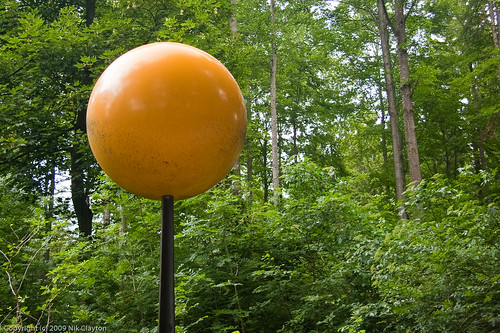
The Swiss love walking, especially the German Swiss.  From the Zurich train station, the Uetliberg train takes you uphill to a long serpentine park straddling a hill and looking down on the city.  Getting off the train at the beginning of the walk, you are soon confronted with a gigantic yellow sphere on a stick that represents the: Sun.  If you keep on strolling, you come upon a little enclosure housing a tiny sphere the size of a BB that represents the planet Mercury on the same scale.  If you keep on walking, you eventually run into the planet Venus and then the Earth, etc.  The cool thing about the Planet Trail is that the interplanetary distances and sizes are all scaled with one kilometer equal to km = 1 billion km. There are some photos of all the different planets here.

Monday, July 5, 2010

50 Years of myTunes: 1960-2010

Most everybody now has a personal iTunes collection.  I have around 10 GB of material. One of the first things I do whenever I add something is to tag the song with the year it was released.  I do this by overwriting the "genre" entry in the song (I detest sorting music into genre anyway and prefer the chronological tag).  I can click on that column and see my iTunes all neatly chroned by year of release.

A while back I started making friends and relatives CDs with music compilations for their birthday.  Amusingly, this actually led me to go looking for a few songs to fill a few gaps (for some reason the year 2000 is under-represented in my collection).  I now have material going all the way back to the 1930s for such lists.

To make a birthday CD I generally start with a person's "birthsong"- the song that was number 1 on the charts on a certain date. Everybody should identify their birth song.   Follow the links at this old Althouse post (link).  My birth song is Theme From A Summer Place.   Althouse even mocked it here.

LOL!

Other choices for the year 1960 from my list include:

Save The Last Dance For Me ~ The Drifters
Cathy’s Clown ~ The Everly Brothers
Only The Lonely ~ Roy Orbison
Merry Little Minuet ~ The Kingston Trio
Everglades ~ The Kingston Trio
Chain Gang ~ Sam Cooke
Perfidia ~ The Ventures
Walk-Don't Run ~ The Ventures


My favorite from that list is the timeless "Merry Little Minuet" popularized by The Kingston Trio (and not by Tom Lehrer):
They're rioting in Africa. They're starving in Spain. There's hurricanes in Florida, and Texas needs rain.
The whole world is festering with unhappy souls. The French hate the Germans, the Germans hate the Poles.
Italians hate Yugoslavs, South Africans hate the Dutch. And I don't like anybody very much!
But we can be tranquil and thankful and proud, for man's been endowed with a mushroom-shaped cloud.
And we know for certain that some lovely day, someone will set the spark off... and we will all be blown away.
They're rioting in Africa. There's strife in Iran. What nature doesn't do to us... will be done by our fellow man.  
~Sheldon Harnick

Sunday, July 4, 2010

Happy Fourth Of July!


I could be wrong but I think that B of A building and trolley tracks are in downtown San Francisco.

Friday, July 2, 2010

Letters Home: "We Saw A Parade For Taft"


The rather personal narrative of my dad's letters occasionally runs across concurrent American history.  Here is one such letter.  He mentions passing through Chicago on the day before the historic 1952 Republican Convention, a crucial event in mainstream American politics.  It's not clear from his letter if he even knew that the convention was happening--he was never overtly political and being only 19 at the time wasn't yet old enough to vote--but I'm fairly certain that my grandfather was keenly interested in that election, hence the mention of seeing a parade for Robert Taft:

July 7, 1952 
Fort Campbell, KY
Dear Mom and Dad and all,
I got back Monday morning at 1:00 o’clock so I got 4 hours sleep. [1] We had good luck all the way. A new Hudson brought us about 300 miles. [2]  We didn’t start hitchhiking till 2:00 Sunday afternoon from Hammond Ind. [3]  When we went through Chicago, we saw a parade for Taft. [4] He was going to be there at 3:30 Sunday afternoon.
We aren’t doing anything today so I’m resting up, and writing this. I am going to Clarksville Tenn. tonight and get Jr. a muffler for his pickup. It’s 9 miles away. Sure is hot down here today, about 100.  Maybe after I get overseas there will be more to write. The way it is there is nothing new here. We have to go through the infiltration course again. [5] I went through it at Ft. Knox, but you have to do it at least within 3 months before you go overseas. It’s been more than 3 months since I went through it. That’s where you crawl on your back and belly and a machine gun is shooting over your head.
Love,
V.
_________________________

[1] Apparently, he had been to Wisconsin on leave over the Fourth of July and had hitchhiked back to Ft. Campbell.

[2]  A 1952 Hudson looked like this: Link

[3] Hammond, Indiana was another Route 41 town on the southeastern side of Chicago, just west of Gary, Indiana.

[4] Taft was of course Sen. Robert A. Taft, eldest son of William Howard Taft (27th President and later the 10th Chief Justice).  Taft had represented Ohio in the US Senate since 1938 and had twice before sought the Republican nomination. An outspoken critic of FDR's New Deal legislation, Taft often led efforts to curb its excesses, for example, via the Taft-Hartley Act which had overridden President Truman's veto. Taft-Hartley remains in force today. Taft also opposed unchecked deficit spending, high farm subsidies, excess governmental bureaucracy, the National Labor Relations Board, and nationalized health insurance.

Robert Taft was unloved by the eastern Republican establishment, personified by his arch rival, New York Governor (and three-time presidential candidate) Thomas E. Dewey. Taft was harshly criticized in the press for opposing the execution of Nazi War criminals at Nuremberg; he considered it ex post facto law and a precedent that we would later regret. Taft also opposed the Korean War, basing his opposition not on softness towards communism but instead on the way in which the conflict began--Taft simply opposed the usurpation of Congressional War Powers by President Truman. Again Taft called it a precedent that we would later regret.

JFK posthumously lauded Taft (along with seven others) in his Profiles In Courage, calling him "Mr. Republican" and "Mr. Integrity." And while Taft inspired respect from both sides of politics and loyalty from Republican partisans, he was ultimately considered unelectable to the Presidency by his own party.

The outcome of the Republican Presidential primary in Chicago was still uncertain that first weekend in early July, 1952.  Those were still the days when conventions were decided by men in smoke-filled rooms.  Neither Eisenhower nor Taft had a majority of delegate votes needed going into the convention. Each man represented differing factions within the same party, yet nothing seemed to be a deciding factor other than the inchoate "electability" factor of Eisenhower.  And that was just it.  Ike was liked. Well liked. The general had famously rejected candidacy four years before in 1948, despite a nascent and popular "draft Ike" movement. Hardcore Republican delegates were loyal to Taft, but in the end they listened to their constituents.  One-by-one during the next week of the convention they found ways to switch from Taft to Eisenhower.

The following passage is from William Manchester's historical narrative, The Glory And The Dream. Manchester describes the pivotal (televised!) moment as the convention delegates decisively turned against Taft, switching to Eisenhower:
He [Eisenhower] had watched it on television in his suite at the Blackstone Hotel, standing with his four brothers and nervously fingering two good luck charms, a Salvation Army coin and a Boy Scout souvenir. As Minnesota switched, Herbert Brownell rushed up and embraced him. The general’s eyes filled. Too moved to speak, he sought out Mamie for a private moment. Then he picked up a phone and asked to speak to Taft. It was precisely the right thing to do, and he, the presumed amateur in politics, was the one who had thought of it. He asked the senator if he could pay his respects. Fighting crowds all the way, he made his way to Taft’s lair in the Conrad Hilton. Both men were exhausted, stunned and dazed. Photographers begged them to smile. They complied, though Taft was clearly in agony.  He was going through this for the sake of the party, and his devotion to it had never made a greater demand. Though his eyes were bleak with pain, he managed to keep on grinning. He said huskily, “I want to congratulate General Eisenhower.  I shall do everything possible in the campaign to secure his election and to cooperate with him in his administration."
Eisenhower emerged victorious from Chicago and Richard Nixon of California was unanimously selected as his running mate. Of course Ike went on to win the 1952 Presidential election, defeating Adlai Stevenson that November (and again in 1956).

Taft enjoyed a brief stint as Senate Majority leader as the Republicans swept back into power with Eisenhower, but he died unexpectedly of cancer the following year, aged 63.

An inscription at the Robert A. Taft Memorial and Carillon in Washington DC reads:
This Memorial to Robert A. Taft, presented by the people to the Congress of the United States, stands as a tribute to the honesty, indomitable courage, and high principles of free government symbolized by his life.

[5] My dad had described the infiltration course back here.

Wednesday, June 30, 2010

The Auction

June 30th, 1978:

Car doors slammed in the summer morning, jarring me awake.  Looking out my window, I saw cars quickly lining the curbs and people gathering at a neighbor's house a few doors down. I went out to investigate.

A strange truck was parked in front of the M. family's house. "Earl Culp & Sons, Auctioneers" read the signage on the truck's door.  I quickly figured out what was going on. The strangers were buyers who had come for an auction. A neighbor had died and an estate auction was in action.

My neighbor, Mr. M., had been a professor at the local university.  Thinking back, I still picture him as Dr. Quest from the cartoon Jonny Quest--right down to the red hair and beard.  We kids never thought to call him professor or doctor--only just Mr. M.  For one thing it would have been incorrect and improper to call him by those other titles because at that time and place we only called medical doctors "doctor". 

We all knew that Mr. M. was smart. We had heard that he had played some important role in the space program in the 1960s -- or so our mom had told us.  She said that Mr. M. had computers in his basement which was weird because back then nobody had computers at home. My mom had also heard that Mr. M. had to install cellar doors to get them into his basement because they were so big. 

[I found out only recently that he had been an astronomy professor at the university and that his research had helped to put weather satellites into orbit]

By that June of 1978, Mr. M had been dying of cancer for a year or two, slowly thinning and weakening, and finally he died. Before that, I used to see him at the local diner where I worked part-time after school. He had many friends with whom he used to share coffee and good times. Mrs. M. had been mentally ill for several years and was "hospitalized." My mom met her when we moved into the neighborhood in the early 1960's -- before she really went downhill. Mrs. M that is. My mom said that Mrs. M. had started hearing voices and that she suffered from dementia.

[I recently learned that she also suffered from pernicious anemia and passed away a few years after her husband]

The M. family loved the outdoors. They kept a small pop-up tent trailer in their double garage and they had a canoe which hung next to it on the wall.  Sometimes at night walking by, I caught a glimpse of a telescope and model aircraft through an unshaded window.

The auction was necessary to sell the M's remaining belongings. After registering with the auctioneer, the buyers circulated among the furniture and household items which had been moved from inside the house to the front lawn. Much of the stuff must have had personal value to the M. family--the kind of stuff one sees at a garage sale. Several folding tables had been set up and were heaped with various groupings of household items sorted into lots of three, four and five related items.  My attention fixed on one particular lot comprising a silver teapot, two collector's liquor decanters, a ceramic planter, and some pieces of home made embroidery.  I looked around at the buyers and waited for the auction to begin.

Many buyers, having arrived in the early cool of the morning, sought shade as the full noon sun began to beat down. It must have been 90 degrees in the shade. The house was open and so I went inside for the first time in my life. Only my mom had been inside before--she used to have coffee in there with Mrs. M.  Most of the furniture had already been moved outside. Only the bigger and heavier items were left inside. The single storey house had a big picture window that looked down on a backyard. I walked over to it and looked out.

They had a very private backyard--it was ringed by enormous pine trees and bushes so thick that they secluded the grassy area in the middle. From inside the house, that space looked like a clearing in a pine forest. Just beyond the ring of pines and bushes stood an enormous solitary oak tree--so old that it pre-dated the entire neighborhood. The tree was actually not on their property but stood just outside it. When I was kid there was open field back there so we didn't have to trespass to get to the tree. That oak was the biggest and best climbing tree in the neighborhood. Someone long before had nailed boards into the trunk so that we could actually get up into the thing. The oak rose higher than the bushes and pines ringing their yard and it too looked down on the grassy middle that I was looking at. I had seen that same grassy space from a perch in that oak as a much younger child.  I'd even been in that grassy space once or twice with other kids when we snuck in there when we thought nobody was looking, just to look at the concrete-lined fish pond where they kept goldfish year round [a koi pond?]  We'd never seen anything like that before in Wisconsin--especially in the 1960s.

I thought back to how we used to play on that tree as kids. Because of the slight slope to the yard, the picture window was about level with where I used to sit and play in that big oak. The perspective was different--when I was kid I could see the window I was looking through now from the tree but I couldn't see inside the house.  Now, years later, I was looking through that window at the same tree across the same yard where I used to perch.

The auctioneer snapped me back to attention and I so went back outside.

One of the Culps (maybe the old man Culp himself) started the auction promptly at noon. I had been to but had never bid at an auction before and was excited. Buyers quickly gathered around the first table heaped with various household articles. The auctioneer began chanting:
...one-dollar-bid-now-two-now-two-would-you-gimme-three-now three now three?
two-dollar-bid-now-three-now-three-now-three-would-you-gimme-four?...
One by one, each household lot was sold; some buyers moved away, having bought their target lot; others moved in, bidding on different lots. I stood back watching, listening to the auctioneer's chant. Each table was bought clean, leaving behind a barren surface and the stark legs of the folding table. I circled among the buyers and around the other tables still laden with things, always keeping my eye on "my" lot, patiently waiting. At last the bidding moved to my table and to my lot. I quickly bid, then again, then waited while the last round of bidding circled the table. The auctioneer nodded to me and I was pleased with the bargain and moved to the shade of a tree to watch the other buyers and to rest.

Near the end of the auction, Mrs. M. arrived with her son John. I hardly recognized them and hadn't seen either of them in years.  The M's were both older than my parents and their kids were in high school when we were little so we didn't play with them at all.  Pale and weakened, Mrs. M. walked with difficulty, steadied by John.  She had an ace bandage wrapped around her head and she moved unrecognized among the buyers, talking softly to herself while her son spoke softly to her as if to comfort her and also, perhaps, to calm her. They stopped in front of a large queen-sized headboard made of carved dark wood that a young couple had just bought. 

"How much did the bed sell for?" asked Mrs. M.  A young man, not knowing at all to whom he was speaking, confided his bargain. Mrs. M. just shook her head and looked confused, but her son whisked her away before she could protest. Mother and son then continued to survey the auction, their identities known to me and perhaps a few others. They didn't recognize me at all.

And so the M. family's possessions were sold and scattered: one couple struggled to load a heavy dresser while another carried away the living room sofa. At the day's end, the house stood empty looking even more hollowed out. The buyers departed, returning to where they had come from. The house itself was eventually sold to a young family.  I remember feeling a little sad afterwards--enough to write down a few details so that I wouldn't forget.

[Now I sometimes worry that guys like my neighbor, Mr. M., guys who did all the brain work in the '60s that we all take for granted will just dry up and disappear one day. And all that will remain will be a headstone in some cemetery]

Tuesday, June 29, 2010

Forgotten Americans: Jack Thayer, Titanic Survivor


My grandmother had that book and I loved it so much as a kid that she gave it to me. Logan Marshall's The Sinking of the Titanic and Great Sea Disasters was rushed into print in 1912 shortly after the disaster. Inside are several accounts of survivors, some of whom later became immortalized in the movie Titanic (which I won't link to out of spite for James Cameron).

Jack Thayer was 17 and travelling with his parents. His wiki bio is here.  He was first to insist that the Titanic split in two when she went down. Here are the drawings that Thayer made while on board the rescue ship Carpathia and his description of the Titanic's final moments as published in 1912:


...I jumped out, feet first.  I was clear of the ship; went down, and as I came up I was pushed away from the ship by some force. I came up facing the ship, and one of the funnels seemed to be lifted off and fell towards me about 15 yards away, with a mass of sparks and steam coming out of it. I saw the ship in a sort of a red glare, and it seemed to me that she broke in two just in front of the third funnel.
This time I was sucked down, and as I came up I was pushed out again and twisted around by a large wave, coming up in the midst of a great deal of small wreckage. As I pushed my hand from my head it touched the cork fender of an overturned life-boat. I looked up and saw some men on the top and asked them to give me a hand. One of them, who was a stoker, helped me up. In a short time the bottom was covered with about twenty-five or thirty men. When I got on this I was facing the ship.
The stern then seemed to rise in the air and stopped at about an angle of 60 degrees.  It seemed to hold there for a time and then with a hissing sound it shot right down out of sight with people jumping from the stern.  The stern either pivoted around towards our boat, or we were sucked toward it, and as we only had one oar we could not keep away.  There did not seem to be much suction and most of us managed to stay on the bottom of our boat.

Thayer's theory was dismissed for 70 years until Robert Ballard used his account to help locate the wreck--which he found in two pieces--just as Thayer had said.

For those who have kids: some little models used to be commercially available that reproduce the exact way that the ship sank: link. I own one.  Fun for the kids and grown-up kids alike.

Monday, June 28, 2010

Sorry Mr. Wright, Cash And Carry Only


My stepfather told me a great story.  In 1948 he was working at a department store on the Capitol Square in Madison. In those days, there were no malls and all the major stores were still downtown on the Square. My stepfather was about 18 or 19 and was working his first job. He worked on the third floor where dry goods were stored and unpacked before moving them down to the retail space on the ground floor and second story. It sounds kind of inefficient but the customers didn't want to climb to the third floor (where it was also hotter in the summer) and so it was used in lieu of a basement for storage.

One day, a rather odd-looking man (a dapper Dan my stepfather called  him) came in with a couple other younger guys. My stepfather's supervisor nudged him and said:

"Hey you know who that is?"
 
"No" 

"That's Frank Lloyd Wright" 

Wright had driven over to Madison on Highway 14 with a couple students and was shopping for housewares for the school he ran back in Spring Green. Wright was dressed in a full-length overcoat and "that hat" (my stepfather called it a "sombrero" and recognized "it" when I showed him the photo that I pasted in above).  [Aside: I'm not sure if that hat was really so different from what other distinguished men wore at the time-Robert Oppenheimer for example was famous for his pork pie hat--so famous that the journal Physics Today honored him by posing a photo of just a pork pie hat for its cover in 1948 (link)].

Wright must have been about 80 years old in 1948. He came up to the third floor, avoiding the retail space and went to where houseware items were stored.  Wright carried a cane too and used it to point out things that he wanted as he moved amongst the shelved housewares. He selected three or four wicker basketfuls of dishes--cups, saucers, plates, silver, cookware, etc. My stepfather watched him and then packed up the stuff for him. Afterwards, his boss nudged him again and said:

 "Watch, I bet they make him pay in cash." 

And they did. Wright had an awful reputation for not paying bills. It seems that in his lifetime, the little people were never grateful enough to forgive him his pecuniary trespasses. Just as well. The townspeople in Richland Center dithered for decades before deciding to even recognize their native son. They still haven't put up any kind of civic memorial that I know of--they're still waiting for the memory of unpaid debts to fade.  So far as I know, the best memorial is the one Wright made himself: the old German Warehouse, which I saw and wondered at many times as a kid when we visited that town.

Sunday, June 27, 2010

For What It's Worth: I Saw A Buffalo Springfield

Well not the Buffalo Springfield.  I did see an old Buffalo-Springfield steamroller today at the Antique Gas & Steam Engine Museum in Vista CA:


The parade MC said that the Buffalo-Springfield was one of just a few remaining working examples of something once so commonplace that it gave rise to a verb: "to steamroll".

And the band really did take their name from that machine. So there's this:


That's Neil Young plucking those harmonic pings in the background. You can see him behind frontman Stephen Stills in the very beginning and again when it cuts out at 1 min 13 s.  Sorry that the video cuts out like that.  If anybody knows a better link to the whole Smothers Brothers version of the song, please link in the comments.

Sunday, June 20, 2010

Letters Home: "I guess we won’t be near any big cities over there. Back in the sticks"

No way could my dad have known that I'd be reading and poring through his old letters written to his family while in the service 58 years ago. The complete set of letters can be found by clicking on the tag "Letters Home".

Happy Father's Day!


June 20, 1952
Fort Campbell
8:00 fri nite
Dear Mom and Dad and All,
Its been another hot day. I went swimming after the sun went down.  I lost my billfold Tuesday and nobody has turned it in yet. I had $14.00 in it and my I.D. card. I don’t know what I will do about my drivers licenses. They expired November 4th. [1] Maybe dad can find out down to the police station. [2] I suppose they will say wait till I get out of the Army. If I do that I would have to take my tests and all that red tape. My Social Security Card can wait till I get out.  I got a card in my box to send in if I was ever to lose that. Sure made me mad. I don’t think I’ll buy another one. Just send all my money home instead of half of it.
I’m taking guard for another guy tomorrow for $15.00. [3] Its just starting to rain. First time in 15 days.  I haven’t been off post since I’ve been back. Maybe if I stay in I can earn some extra money to send home.
I heard we got only 23 months for going to Europe. That means 15 more months to go. Jr. had three months taken off for going to Korea. It works the same way. I guess we won’t be near any big cities over there. Back in the sticks.
Sunday nite
I just got back from swimming. Nothing new happened today so I just have well finished this Friday. Still haven’t found my billfold. Just as well forget it.
love,
V.
________________________________
[1] I have no clue why he used the plural. It's not a typo or a grammatical error. I'm certain that he had no driver's license other than the one issued by the State of Wisconsin.

[2] There's that construction "down to" again.  I considered it back here briefly. Written like he spoke.

[3] Gotta wonder if doing some else's guard duty for pay was (a) legal or (b) tolerated by the military at the time. But there you have it- a frank admission of a way to use the system.

[4] "so I just have well finished this Friday" or [because nothing new happened] I may just as well have finished this letter on Friday.

Friday, June 18, 2010

(Untitled)

Why I don't believe in intergenerational grievance mongering:

But God's own descent 
Into flesh was meant
As a demonstration
That the supreme merit
Lay in risking spirit
In substantiation.
Spirit enters flesh
And for all it's worth
Charges into earth
In birth after birth
Ever fresh and fresh.
We may take the view
That its derring-do
Thought of in the large
Is one mighty charge
On our human part
Of the soul's ethereal
Into the material.

~Robert Frost    

Thursday, June 17, 2010

More Bloghetti Carbonara

Carbon dioxide is like the burned-out skeleton of a once juicy hydrocarbon. Drawing out the Lewis structure, the double bonds remind me of the radius and ulna bones in the forearm:

O=C=O


Soft tissues (which are mostly water) show up as lighter shadows in X-rays. Magnetic Resonance Imaging (MRI) is a complementary technique that locates water's hydrogen in soft tissues. And that's exactly what's missing in CO2--all the hydrogen. Hydrocarbons get all the hydrogen and electrons sucked out of them when they burn, transferring them to electronically rapacious oxygen:

CH4   +   2 O2   →  CO2   +   2 H2O

Of course plants and bacteria carry out the reverse reaction, converting CO2 to sugars, but it's possible to synthetically convert carbon dioxide into methanol or even methane using dihydrogen:


But making hydrogen requires energy too.  Making nitrogen fertilizers uses lots of hydrogen, so those serious about fuel supplies will also have to worry about food supplies.  I just wish the same people who talk about shutting down industries and exacting revenge would instead busy themselves with showing that alternatives can be successfully commercialized, because if they can't there's little sense in using them. Energy independence will not come from government investing in unworkable alternatives.  Energy independence can only come from the use and exploitation of domestic energy sources and this includes coal. Oil and related hydrocarbons are intrinsically cheap.  If we decide to move away from them because we don't like or can't shoulder the associated problems, e.g., keeping the free flow free, we'd better prepare for somebody else doing the dirty jobs. And to the winner goes the spoils.

A Brief History Of Earthquakes In Los Angeles


A while back I blogged some excerpts from a wonderful book called The Discovery of San Francisco Bay:  The Portola Expedition of 1769-1770.  The book is a translation of the diary of Miguel Costanso who was a soldier/engineer along that historic expedition up the coast of Southern California.  I love the book's vivid description of the physical geography of Southern California, which must count as the first written description. Costanso wrote a description of the valley where we live which I already blogged about here.

We been having more earthquakes than usual lately.  They have been medium-sized and located quite a distance from here.  Nevertheless, I decided to revisit the Portola Expedition because I recall how vividly he described the earthquakes in the L.A. basin as they passed through that summer in 1769. Turns out earthquakes occurred daily.  Here are his descriptions; the notes are partially from the book and partially mine.
Friday,  July 28 1769--From Santiago we went to another place of which the scouts gave us particulars. It was not far, in truth, since we arrived after an hour's march. It was a beautiful river, and carries great floods in the rainy season, as is apparent from its bed and the sand along its banks. This place has many groves of willows and very good soil, all of which can be irrigated for a great distance.
We pitched our camp on the left bank of the river. To the right there is a populous Indian village; the inhabitants received us with great kindness. Fifty-two of them came to our quarters, and their captain or cacique asked us by signs which we understood easily,  accompanied by by many entreaties, to remain there and live with them. [He said] that they would provide antelopes, hares, or seeds for our subsistence, that the lands which we saw were theirs, and that they would share them with us.
At this place we experienced a terrible earthquake, which was repeated four times during the day.  The first vibration or shock occurred at one o'clock in the afternoon, and was the most violent; the last took place at about half past four. One of the natives who, no doubt, held the office of priest among them, was at the time in the camp. Bewildered, no less than we, by the event, he began, with horrible cries and great manifestations of terror, to entreat the heavens, turning in all directions, and acting as though he would exorcise the elements. To this place we gave the name of Rio de los Temblores. [17]
[17] "Earthquake River" The river became known as the Santa Ana river.  Their campsite was east of Anaheim, near present day Olive.
Sunday, July 30--We left Los Ojitos, [18] where there was another earthquake of no great violence, at half-past six in the morning.  We crossed the plain in a northerly direction, steadily approaching the mountains. We ascended some hills which were quite rugged and high; [19] afterwards we descended to a very extensive and pleasant valley where there was an abundance of water, part of it running in deep ditches, part of it standing so as to form marshes.  This valley must be nearly three leagues in width and very much more in length.  We pitched our camp near a ditch of running water, its banks covered with watercress and cumin.  We gave this place the name of Valle de San Miguel. [20]  It is, perhaps, about four leagues from Los Ojitos.  In the afternoon we felt another earthquake.
[18] "Little Springs" Present day La Brea Canyon, north of Fullerton.
[19] The Puente Hills, probably on the route now followed by Hacienda Boulevard.
[20] Now called the San Gabriel Valley. The camp was near the community of Bassett.
Monday, July 31---We left the camping place at seven o'clock in the morning, and crossing the ditch over which we had to lay a bridge on account of the depth, we traveled for two leagues to the west-northwest through fields of dry grass and thickets, which detained us for a long time as it was necessary to clear a path at every step. We crossed a very muddy stream and camped farther on in an open clear spot in the same valley, and close to a gap which was seen to the west. [21]  At half-past eight in the morning we experienced another violent earthquake.
[21] They camped north of the Whittier Narrows.
Tuesday, August 1---We rested today, and the scouts went out to explore the country.
At ten o'clock in the morning there was an earthquake, which was repeated with violence at one o'clock in the afternoon; and one hour afterwards we experienced another shock.  Some of the soldiers asked permission to go hunting mounted on their horses and others to go on foot, with the intention of killing some antelopes, as many of these animals had been seen.  They are a species of wild goat with horns somewhat larger than those of the goats. These soldiers, on their return, said that they had seen a river of fine water--from sixteen to seventeen yards wide--that rises near the gap of the valley to the south, and at the foot of a low hill that was in sight of our camp, and, at the most, half a league distant.
Wednesday, August 2--In the morning we broke camp, and travelling towards the west, we left the valley by an opening formed between low hills.  Later we entered quite an extensive canyon containing many poplars and alders, among which a bountiful river flowed from the north-northwest, and turning the point of a small steep hill it afterwards continued its course to the south. [22]
To the north-northeast one could see another watercourse or river bed that formed a wide ravine, but it was dry. [23] This watercourse joined that of the river, and give clear indications of heavy floods during the rainy season, as it had many branches of trees and debris on its sides. We halted at this place, which was named La Porciuncula. Here we felt three successive earthquakes during the afternoon and night.
[22] They were at the Los Angeles River, approximately where North Broadway bridges the river. The "small steep hill" is the southeastern portion of Elysian Park--about three-fourths of a mile east of Dodger Stadium.  Elysian Park as is looks today:
[23] Arroyo Seco
Juan Crespí, a Franciscan padre along on the trip, named the river El Río de Nuestra Señora la Reina de los Ángeles de Porciúncula, which translates as The River of Our Lady Queen of the Angels of Porciuncula. This the origin of the name Los Angeles.  There's an interesting story behind that name which goes back to St. Francis of Assisi which you can read about here.
Thursday, August 3---We forded the Rio de la Porciúncula, which descends with great rapidity from the canyon through which it leaves the mountains and enters the plain.  We directed our course to the west-southwest over high level ground and, after a march of three leagues, we reached a watering-place, to which we gave the name of the Ojo de Agua de los Alisos. [24] This was a large spring situated in a marshy place where there stood some alder trees of very large girth; the marsh was covered with grass, fragrant plants, and watercress. Hence the water flowed through a deep ditch towards the southwest.  All the country that we saw on this day's march appeared to us most suitable for the production of all kinds of grain and fruit. On our way we met the entire population of an Indian village engaged in harvesting seeds on the plain.
In the afternoon there were other earthquakes; the frequency of them amazed us.  Someone was convinced that there were large volcanoes in the mountain range that lay in front of us extending towards the west.  We found sufficient indications of this on the way that lies between between the Rio de la Porciúncula and the Ojo de Agua de los Alisos, as the scouts saw, adjoining the mountains, some large swamps of a certain material like pitch which was bubbling up. [25]
[24] "Alder (Sycamore) Springs", approximately at La Cienega Park, on La Cienega Boulevard between Olympic Boulevard and Gregory Way.  The phrase ojo de agua (eye of water) was often used in naming springs: an eye in the ground, whence water flowed or seeped.
[25] The La Brea Tar Pits. "Brea" means tar in Spanish.  While there aren't any active volcanoes in L.A. there are other natural oil and gas seepages like Coal Oil Point just offshore.

Tuesday, June 15, 2010

Letters Home: Heatwaves, Foreign Cars & Fireworks


June 16, 1952
Fort Campbell KY

Dear Mom and Dad and All,

Its sure been hot here for the last week ever since I’ve been back. I’ve been going swimming everyday for a week. It’s too hot to work so we get the afternoons off.

We found out today we are going to Germany for sure. How’s Jr. getting along at McCoy? Have him ask Erwin where Cecil is stationed over there.  Nothing new has been happening here lately. We got prisoner guard coming up the 21st that lasts a week. I suppose all us new Duces will catch it. [1]

We get a long weekend over the Fourth of July. I might send some firecrackers home. We can get all kinds of them. [2]


Has Dad found a car he wants yet? I think he should trade for a new Ford or Chev. [3]  Has Jr. done anything to the truck yet? I mean the old Ford. What all was wrong with the hot rod?


This is all for this time


Love,
V.
__________

[1] "new Duces"?  I can't find the origin of or reference for this term.  Here is a scan of the original letter:

up 21st that last a 
week. I suppose all us 
new pals Duces will 
catch it. 
We get a long weekend over 
the fourth of July. I might
send some firecrackers home.   
We can get all kinds of them. 
   Has dad found a car he 
wants yet? 

If anybody can suggest a meaning I'd sure appreciate knowing it.

[2] My dad stopped at roadside fireworks stand in Tennessee on our epic Highway 41 roadtrip. I remember gawking at all the fireworks for sale: firecrackers, cherry bombs, bottle rockets. They sold them to pretty much anyone too. A couple years later I saw the same thing in South Dakota on a family vacation to the Black Hills.

Fireworks laws in Wisconsin are very restrictive. I wonder where this stricture came from exactly and it's interesting that it was already there in the early 1950's.  I'm speculating that it dates from the "do-gooder" days of Progressive politics in Wisconsin where civic-minded people sought to protect people from themselves. Fireworks are dangerous. I almost blew a couple fingers off as a teen when a string of firecrackers I was holding went off in my hand.  Yet still the lure of blowing things up with minature sticks of dynamite was too much to resist.

[3] "Chev."  I wonder what General Motors management would think of that abbreviation. If I recall, my dad and his brothers never said "Chevrolet" and rarely "Chevy"; instead they said "Chev" and pronounced it "shiv". Back then there really only were domestic cars available. But like so many men of his generation, my dad never owned a foreign car make. I'm not sure he ever even drove one.  He did own a couple GM cars, but he mostly stayed loyal to FoMoCo products, especially the Mustang.  It's not like he loved American-made stuff per se--he was a fan of Wal-Mart too and the "cheapest available".  But with cars it was a like a line in the sand.  He had brothers who worked at GM and Chrysler, so maybe he never wanted to face their scorn and derision.

Presidential Politics: 1972


My favorites are the two in the bottom left.

Saturday, June 12, 2010

Close Encounters of the Flash Flood Kind

[Image Removed By Request Of Copyright Owner]

Back in the summer of 1972 our family went on a camping trip out west to the Black Hills of South Dakota and also to Wyoming. We drove I-90 all the way with stops at Mitchell's Corn Palace, the Badlands, Wall Drug Store, Mt. Rushmore and Devil's Tower. There were four people, a dog and a sick rat in a rat cage in a 1966 Mustang pulling a small trailer. How we did that must have amazed my parents.

Back then our people's sensitivities towards Native Americans (or Indians as we still called them) were just emerging.  I learned only later that the Black Hills were sacred to the Sioux and that my people had effectively desecrated their land by carving up Mt. Rushmore. At the time, Crazy Horse Monument wasn't much to look at yet.

We camped at a campground near Keystone, SD very near Mt. Rushmore. After that we moved on to Wyoming and spent a couple days at Devil's Tower National Monument. On the return trip, we passed back through the Black Hills and then spent the night outside of Rapid City so as to be poised for the interstate sprint across the plains back east along I-90. My dad was always a big proponent of splurging on a motel before heading back home on his road trips. It rained that night and we awoke early, probably catching a bite to eat before hitting the road--I really don't recall.  What I do remember is tuning into the AM radio as as we drove back east to Wisconsin. Cracking AM radio reports of flash flood destruction struck us dumb, especially as the local news described how places and campsites that we had just visited had literally been swept away during the night. I don't think that any of us had ever come so close to harm's way before or since.

Here's a description of the flash flood: Link

Tuesday, June 8, 2010

Letters Home: Rollin' Down Highway 41


June 9, 1952
Fort Campbell KY
Dear Mom and Dad and All,
I made it back Sunday afternoon at 2:00. I was going to call up at 9:00 Sat. night from Evansville, Ind. but it took me a couple of hours to find a room for the night. I finally found one, a boarding house. Evansville is only 125 miles from here so I made good time Sat. [1]
Sure has been hot here- today 95 or 100.  I mowed a little grass today and I didn’t do anything in the afternoon. [2]  From 7 to 8 in the mornings we have P.T. and Dismounted Drill. [3] Tomorrow we are supposed to play baseball and go swimming.
Still going to Europe. Leaving from New Orleans. I don’t think they will change the plans now.
What is R. going to do with his Hot Rod? How is the Mercury running? It’s about time the oil was changed in it.
I guess this is all the news for this time. Nothing much happening here lately.  I sure miss the car.
Love, 
V.
________________

[1] My dad must have driven his car back north for safe-keeping and then hitchhiked back to camp. He would have never stopped 2 hrs short of his goal if he had been driving.   Evansville, Indiana is an Ohio river town on US Route 41, which at that time was a main North-South route in the days before the Interstate Highway System. Congress didn't authorize the interstate system that we now depend on until 4 years later during the Eisenhower administration. Railroads were already dying and Ike was a big proponent of interstate highways having seen firsthand the German Autobahn system during WW II.

16 years later, in 1968, my dad took us on an epic family station wagon vacation to Florida (really we were just along for the ride on his dive trip to FL :). We followed old Route 41 for most of it with stops at Mammoth Cave KY, Chattanooga TN, somewhere in south Georgia, Weeki Wachee FL, Miami, Key West, Daytona, etc... I'm thinking of blogging a series about that epic vacation after I learn to slice and dice some 8 mm footage that I had converted into DVD format. Maybe I'll even record voice-over narration.  There are some photos somewhere too from that trip--probably in my brother's basement which I need to snag.

[2] Did you know that hair (like grass) grows faster in the summer?  I heard this from a barber once and thought little of it until I sat down to write this. Speaking of mowing lawns, we recently bought one of these.  I had procrastinated for years about getting a cordless electric mower. It's not the one I wanted which is a Bosch lithium ion battery mower, but my wife got fed up with the waiting and just bought it. My son now loves mowing the lawn.

[3] Dismounted Drill and P.T. (physical fitness testing).


Monday, June 7, 2010

Freya von Moltke Never Went Back To Poland

Life has taught us that love does not consist in gazing at each other but in looking outward together in the same direction.
-Antoine de Saint-Exupery
Freya von Moltke (1911-2010)
Freya von Moltke passed away almost unnoticed early this year.  I was twittering around late one night last spring and came across her book, Memories of Kreisau and the German Resistance. I was interested in her husband, Helmuth James Graf von Moltke, after having watched Sophie Scholl: Die Letzten Tage

Memories of Kreisau & The German Resistance is a slim volume which I read through in a weekend. I marked a couple passages with yellow stickies that I thought might be worth remembering.  Here she writes about what motivated her husband and his friends:
However, questions of faith were also, or became, personally vital for almost all the members of the group.  Even if they were not churchgoing Christians, it was their faith in divine work, and, in fact, the faith rooted in Christian heritage, that gave them their foundation and their courage.  Their faith also imposed upon them the duty to act against the destruction of fundamental humanity (evolved from Christianity) by National Socialism and to risk their lives for this. However, for them it was not only a matter of great heritage, out of which our western treasures had grown, in spite of all atrocities committed by the church and by Christians throughout the centuries; rather, they also believed in the future of Christianity.  Christianity has a way--just when it appears bankrupt--of becoming alive again in a new and different manner. They believed that. Faith is tested by one's actions. People attach themselves to many gods and are always in danger of being led astray by false gods--as was the case then with the false gods of National Socialism.
Her husband, Helmuth James von Moltke, was one of Germany's best legal minds of his generation.  He was arrested, charged with conspiracy, and executed just months before the end of the war.  Freya said of her husband:
Whoever wants to become acquainted with Helmuth, must read his letters. He is not easy to describe, especially not for me. 
Helmuth James von Moltke's  Letters To Freya (1939-45) is over 400 pages long and set in extremely small type font. He details in an unbroken series of letters to his wife the minutia of his thoughts on all matters as seen from someone inside the Third Reich on the other side.  The diarist narrative gets a bit bogged down in places and I admit that I skipped around, unlike Memories of Kreisau.

Imprisoned for a year, then tried and summarily executed, von Moltke wrote to his sons from prison (then aged just 3 and 6) calling their mother by her name and choosing words which they could not possibly have understood then:
...Ever since National Socialism came to power, I have done my best to mitigate the consequences for its victims and to prepare for a change. I was driven to it by my conscience, and, after all, it is a task for a man. From 1933 on, I have therefore had to make material sacrifices and to run personal risks. In all these years Freya, who was the one who suffered most from these sacrifices and who always had to be concerned that I would be arrested, imprisoned, or killed, never hindered me in what I considered necessary, or made it harder in any way. She was always ready to accept everything; she was always ready to make sacrifices if it was necessary. And I tell you: that is much more than I did. For running risks oneself, which one knows, is nothing compared with the readiness to let the person with whom one's life is joined run risks one cannot gauge. And it is much more, too, than the wife of a warrior accepts, for she has no choice; one word from Freya might have held me back from many an undertaking.
The very last two letters in Letters To Freya (written after he had been condemned and just days before his execution) are particularly moving and read in part like lyrics--as if written by a man graced with resolve and contentment.   Freya wrote in her book:
I carried Helmuth's commitment with him from the beginning, and therefore, I wanted him to continue....I never advised him to stop, but rather encouraged him, because I was convinced that that was the right way for him to fulfill his life.
It sounds to me like they had a perfect marriage.