Sam Kean wrote a book a couple years back called "The Disappearing Spoon And Other True Tales Of Madness, Love, And The History Of The World From The Periodic Table Of The Elements." I started it but never finished it. A commenter mentioned the book yesterday on Trooper York, and I suggested that we and another should read and discuss it and so I'm going to give that a shot. I'm going to take this very slowly at first in case you want to buy the book and follow along as well.
I read the Intro and Chapter 1 last night and flagged several passages that struck me as either very well expressed or perhaps worthy of further explanation.
Kean arranges his book into parts and chapters and each concerns a specific element or elements.
My style is to assume that the reader has the book and can proceed along with me on this journey. I'm going to drop quotes where I made markers and then write a few words. If I don't say anything about a certain passage, it's not because I think it's good or bad or that I disagree. Feel free to ask questions or challenge me in the comments. This first post isn't very chemical at all and is mostly historical in nature. That changes pretty quickly.
Introduction: Mercury
Kean introduces mercury which he's known since childhood (as no doubt have many of a certain age before the stuff was so shunned). Of course mercury was known to the ancients as well. Page 4, middle of page:
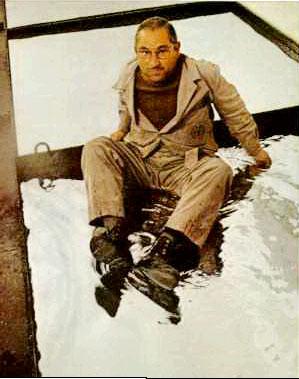
Medieval alchemists, despite their lust for gold, considered mercury the most potent and poetic substance in the universe.Alchemists considered mercury to be the "spirit" of matter and sulfur to be its "soul." The arcane symbols used for the elements are here. In nature, mercury is commonly found combined with sulfur as the mineral cinnabar. The Romans mined the stuff in Spain and some of the mines are still producing it. I linked to photo of a man floating on a vat of mercury and wrote of some of my own experiences with mercury here and here.
Next we learn how Lewis and Clark left telltale signs along their trek because they carried with and used mercuric chloride as a laxative or emetic. Page 5, about 5 lines up from bottom:
With the weird food and questionable water they encountered in the wild, someone in their party was always queasy, and to this day, mercury deposits dot the soil many places were the gang dug a latrine, perhaps after one of Dr. Rush's "Thunderclappers" had worked a little too well.This is fascinating. But it's no surprise because mercury persists in the environment. Ingested as insoluble mercuric chloride, it's likely to stay put as mercuric chloride.
Bottom of page 5:
I latched onto those tales, and recently, while reminiscing about mercury over breakfast, I realized that there's a funny, or odd, or chilling tale attached to every element on the periodic table. At the same time, the table is one of the great intellectual achievements of humankind. It's both a scientific accomplishment and a storybook, and I wrote this book to peel back all of the layers one by one, like the transparencies in an anatomy textbook that tell the same story at different depths.I can relate. I began blogging about the chemical elements after watching 4th of July fireworks 4 years ago: link I too realized that I had personal experience with many of them and I wanted to pull them together in my own way too. I started a series, using the tag "The Elements Series." I intend to use some of these posts along the way. Eventually, I intend to extend the series beyond rhodium.
__________________________________
Next up: Part I "Orientation: Column By Column, Row by Row"
1. Geography Is Destiny