Ruthenium, or Рутений in Russian, was named for Russia. We should call the element russium--that would at least be more historically descriptive--but ruthenium it is.* The first detectable amounts came from platinum ores in the Ural mountains--first discovered in the 1820's. The element is exceedingly rare--and thus expensive--and yet it too has its unique chemical niche.
Ruthenium is the first element in the series 1 to 44 which can be fully stripped of 8 electrons to give a stable oxidation state of VIII.** Step just one atomic number backwards, to technetium, and there aren't 8 valence electrons to lose--only 7; step one element to the right, to rhodium, and the nucleus is already too electronegative to give up more than 6 electrons. This makes ruthenium special--its willingness to fully yield to rapacious oxygen.
Ruthenium isn't really famous for much. It enjoyed brief fame in 1952 when ruthenocene was prepared by analogy to ferrocene, but it always seemed a little under-represented in catalysis until a chemist named Robert Grubbs (originally from Possum Trot holler in Kentucky), put ruthenium on the map with his Nobel-prize winning work centered around olefin metathesis.
"Olefin metathesis" has interesting history as a term--taken apart, "olefin" comes from oléfiant which means oil-forming and which ultimately comes from the roots oleum + facere. Olefin is an old word as chemistry words go--not so old to be practically archaic like oleum or vitriol, but still old. The modern term for olefin is alkene--organic hydrocarbons having one or more unsaturated double bond. The terms "polyunsaturated fat" and "trans fat" refer to olefins, FWIW.
Metathesis is a special word meaning rearrangement. There's a grammatical sense of the word which means transposition, and the chemical sense is just a metaphor. If we let the equal sign be a double bond, olefin metathesis refers to
a=b + c=d --> a=c + b=d.
See what happened there? Transposition.
________________________________
*Ruthenia corresponded to a much smaller region of what is now in the Ukraine. The Ural region was unknown to the Romans.
**Wikipedia notes claims to the existence of Fe(VIII) as in FeO4 but the claim is tentative.
Showing posts with label Inventors. Show all posts
Showing posts with label Inventors. Show all posts
Monday, July 9, 2012


Saturday, March 17, 2012
Titanic Centennial: Stranger Than Fiction?

From the preface to Walter Lord's A Night To Remember:
In 1898, a struggling author named Morgan Robertson concocted a novel about a fabulous Atlantic liner, far larger than any that had ever been built. Robertson loaded his ship with the rich and complacent and then wrecked it one cold April night on an iceberg. This somehow showed the futility of everything, and in fact, the book was called Futility when it appeared that year, published by the firm of M F. Mansfield.
Fourteen years later, a British shipping company named the White Star Line built a steamer remarkably like the one in Robertson's novel. The new liner was 66,000 tons displacement; Robertson's was 70,000 tons. The real ship was 882.5 feet long; the fictional one was 800 feet. Both vessels were were triple screw and could make 24-5 knots. Both could carry about 3,000 people, and both had enough lifeboats for only a fraction of this number. But, then, this didn't seem to matter because both were labelled 'unsinkable.'________________
...
Robertson called his ship the Titan; the White Star Line called its ship the Titanic. This is the story of her last night.
Robertson's uncanny story is linked here. Futility was republished in 1912 as the Wreck of the Titan. Interestingly, Robertson also "invented" the periscope, and predicted a Japanese sneak attack on the US. He died of apparent suicide in 1915.
Saturday, January 21, 2012
Michigan is still well endowed with bromides
 |
| Herbert Henry Dow (1866-1930) |
I just ordered an old biography about Herbert H. Dow. I don't own a kindle, so I tend to collect books. I have lots of older books too.
Herbert Dow based his eponymous company in Midland, Michigan because he found lots of bromide ion in the water there. I learned that when I visited there--years ago--to help a company evaluate some technology they were buying from Dow.
Dow originally invented a process for producing bromine from bromide and the story of him beating the Germans at their own game fascinates me. I want to read more.
Friday, January 13, 2012
Selènè mooned the Xerox machine*
 |
| Selene, the moon goddess |
Chester Carlson put selenium's photoconductivity to practical use by inventing xerography and founding the Xerox corporation. Carlson patented xerography (which means dry writing in Greek) in 1942 and commercialized it. Selenium's role in xerography was to hold an electrostatic image long enough to attract toner ink for transfer to paper--and then to quickly forget what it saw. Selenium is no longer used in commercial copy machines, but the first ones did. A good historical read is here. Television, then a nascent technology, also used selenium early on. link
Though right next door to arsenic, selenium is not nearly as toxic--though its smell can be nauseating. Selenium disulfide puts the stink in dandruff shampoos, though I'm not sure if it's the selenium or the sulfur--both are chalcogens. Toxic in large doses, selenium is also an essential micro-nutrient, replacing sulfur in amino acids like cysteine and methionine and serving as an anti-oxidant.
__________________
*Element 34, Selenium was named for Σεληνη [Selènè], Greek for Moon. Van der Krogt gives more history of the element's naming. Link
Friday, December 16, 2011
The Man Who First Galvanized The World...
...was Luigi Galvani (1737-1798). In 1791, he discovered that a frog's leg would twitch when touched by static electricity. This in turn galvanized a young gal by the name of Mary Wollstonecraft Shelley. The rest is history.
Not quite. Galvani and Alessandro Volta got into a dispute regarding the nature of electrical effects in nature. Volta went on to invent the battery in 1800 to confute Galvani's notions. That led directly to the discovery of several chemical elements, as I wrote about here
Not quite. Galvani and Alessandro Volta got into a dispute regarding the nature of electrical effects in nature. Volta went on to invent the battery in 1800 to confute Galvani's notions. That led directly to the discovery of several chemical elements, as I wrote about here
Monday, November 28, 2011
They beat Plows into Swords--Male and Female They Created Them
By 1915 the ground war on the Western Front was so entrenched that the British Admiralty, seeking to break the stalemate, developed what were first known as "landships" but which later came to be known by their covert name--tanks. The idea was to develop a machine that could traverse craters, barbed wire, trenches, and bring firepower directly behind enemy lines.
The first landships used a British superstructure atop an American track and chassis built by a Chicago company and originally designed for plowing fields. Early testing and improvements quickly led to a more advanced prototype named "Mother." Her parallelogram-shaped tracks maximized trench crossing and her gun-bearing sponsons, a design borrowed directly from warships, added to her chimerical appearance. The hermaphrodite Mother gave birth to "male" and "female" varieties which were first battle-tested at the Battle of the Somme in 1916.
Male and female variety tanks differed depending on what protruded from the sponsons. Males had the big guns--naval 6 pounders, while females had water-cooled Vickers or Maxim machine guns (two on each side, four total). The reason for the females was an acute shortage of bigger guns. The differences are apparent in this graphic:
The first landships used a British superstructure atop an American track and chassis built by a Chicago company and originally designed for plowing fields. Early testing and improvements quickly led to a more advanced prototype named "Mother." Her parallelogram-shaped tracks maximized trench crossing and her gun-bearing sponsons, a design borrowed directly from warships, added to her chimerical appearance. The hermaphrodite Mother gave birth to "male" and "female" varieties which were first battle-tested at the Battle of the Somme in 1916.
Male and female variety tanks differed depending on what protruded from the sponsons. Males had the big guns--naval 6 pounders, while females had water-cooled Vickers or Maxim machine guns (two on each side, four total). The reason for the females was an acute shortage of bigger guns. The differences are apparent in this graphic:
 |
| Female (top) and male (bottom) Mark I Tanks |
Thursday, October 27, 2011
Ludwig Mond Gave Metal Wings
 |
| Ludwig Mond (1839-1909) founded Britain's ICI. |
Ludwig Mond was another wealth maker who changed chemistry and in so doing, changed the world. Am I giving him too much credit? Perhaps. Mond discovered nickel tetracarbonyl--an insidious poison--and turned its making into a process for refining ultra pure nickel--mostly Canadian nickel from the Sudbury Basin. Such nickel went into steel to make armor plating for ships. I'm sure that some still sits in the sunken battleship USS Arizona at Pearl Harbor.* Hardened steel armor was also the reason the US Treasury had to pull nickel from circulation during World War II, replacing it with less precious silver. link
Mond found (by accident) that nickel combines with four molecules of carbon monoxide to give nickel tetracarbonyl,
Ni(CO)4:

________________
*Kruppstahl as it turns out. I suspected this after having seen one of the Arizona's turrets still half submerged in warm seawater after nearly 70 years!
Monday, August 22, 2011
Men of Iron and Steel
 |
| The Iron Bridge at Ironbridge, Shropshire, England (Original) |
A Briton named Abraham Darby ignited the industrial revolution around 1710 when he substituted coke (from coal) in his recipe for ironmaking. Traditionally, iron ore had been smelted using charcoal derived from trees (charcoal is "cleaner" carbon). Learning to smelt iron with coke in blast furnaces ultimately freed the iron industry from the natural limits of forests, much like the invention of the automobile would later free arable land from the yoke of producing fodder for horses. Three generations of Darbys stoked the wrought iron age.
Perhaps the most iconic monuments wrought from iron are Gustave Eiffel's eponymous tower in Paris (1889) and the first Ferris Wheel erected in Chicago in 1893 by George Ferris, Jr. Eiffel also designed and produced the wrought iron framework beneath the copper sheathing of our Statue of Liberty. But even these structures were out of date when they were completed.
By the mid-1800's the demand for wrought iron was so great that inventor Henry Bessemer developed and patented the first modern process for making steel (steel is essentially purified pig iron alloyed with other metals). Vastly superior to wrought iron, Bessemer's steel revolution was so successful that it returned wrought iron making to a cottage industry. European steel maker Alfred Krupp adopted the process, and built his company on cannons and railroad wheels. Andrew Carnegie brought the same process to America but also began buying ore-rich land in Minnesota, developing a vertically integrated business model. By the time Carnegie sold his immense fortune to J.P. Morgan in 1901, the price of steel rails had fallen from $160 per ton to $17 per ton. Carnegie devoted the rest of his life to philanthropy, perhaps returning to the promise of an earlier self.*
Subsequent, more efficient processes eventually supplanted the Bessemer process, including the Open Hearth Process, the Basic Oxygen Process and the Electric Arc Process, first patented by Carl Wilhelm Siemens in 1878.
________________
*In December 1868, Carnegie wrote in a "memo to self:"
Man must have an idol and the amassing of wealth is one of the worst species of idolatry! No idol is more debasing than the worship of money! Whatever I engage in I must push inordinately; therefore should I be careful to choose that life which will be the most elevating in its character. To continue much longer overwhelmed by business cares and with most of my thoughts wholly upon the way to make more money in the shortest time, must degrade me beyond hope of permanent recovery. I will resign business at thirty-five, but during these ensuing two years I wish to spend the afternoons in receiving instruction and in reading systematically! Link
Cold Iron is master of them all!
Thursday, July 28, 2011
Djerassic Perk
Here's a long shot of a guess. I don't think the Norwegians will award a Peace Prize this year. Still reeling from the horrible Utoya massacre, they may just put it on hold this year to honor the silenced dead. It might be a fitting gesture.
Of course the Swedes award the science prizes. One name I've always been surprised to see passed over in Chemistry (as if I'm a judge of such things) is Carl Djerassi, co-inventor of the first oral contraceptive for women back in 1951. He had a long career at Stanford University (he's since retired). He's also long been interested in the arts and even writes fiction. Djerassi didn't accomplish the Pill on his own, but many of the important others are now dead and thus ineligible. My casual read of Wikipedia suggests that George Rosenkranz could be a co-contender.
Djerassi foresaw the Pill's huge social impact, anticipating a far greater social impact on men than on women. He apparently also "foresaw the so-called 'feminization of men,' along with changes in laws and social values in favor of women in society as a whole." link
Of course the Swedes award the science prizes. One name I've always been surprised to see passed over in Chemistry (as if I'm a judge of such things) is Carl Djerassi, co-inventor of the first oral contraceptive for women back in 1951. He had a long career at Stanford University (he's since retired). He's also long been interested in the arts and even writes fiction. Djerassi didn't accomplish the Pill on his own, but many of the important others are now dead and thus ineligible. My casual read of Wikipedia suggests that George Rosenkranz could be a co-contender.
Djerassi foresaw the Pill's huge social impact, anticipating a far greater social impact on men than on women. He apparently also "foresaw the so-called 'feminization of men,' along with changes in laws and social values in favor of women in society as a whole." link
Wednesday, July 27, 2011
Irony
Iron has so much history that I may have to make a little hash tag label for it like I did for carbon with bloghetti carbonara. There is just too much for one blog post.
In my last year in college at Madison, I took a graduate level course (Chem 714) called Organometallic Chemistry of the Transition Elements. I may have been the only undergraduate in the course. One of the reading assignments was called "The Iron Sandwich. A Recollection Of The First Four Months" by Geoffrey Wilkinson (Journal of Organometallic Chemistry 1975, 100, 273-278).
Wilkinson narrates the story of how he deduced the correct structure of ferrocene, shortly after its incorrect structure was first published. The work was seminal and led (in part) to his sharing the 1973 Nobel Prize in Chemistry along with E. O. Fischer of Munich.
Here he sets the stage (annoying footnotes are mine):
Wilkinson went on to describe adjusting to Harvard faculty life in a chatty way before focusing on his eureka moment:

 He proposed the two hourglass-shaped structures differing only in how the five-sided rings (the bread slices of the iron sandwich) aligned with each other. He quickly went on to show that other sandwich structures existed for other metals, discovering a new genus of compounds now generically called metallocenes.
One irony in this story is that Harvard failed to offer Wilkinson tenure after he did this prize-worthy work, despite the widespread acclaim it engendered during his time there. Harvard either didn't recognize the importance of his work or, as I suspect, he made some academic enemies there.
I recently found myself at an informal meeting of chemists and a story regarding Harvard Chemistry came up: "Yeah, Harvard--they never tenure anybody" a friend said. After sixty years, they haven't shaken that reputation. To many, Harvard broke the code of not rewarding merit.
Wilkinson's subsequent career certainly didn't suffer. He went on to chair the Department at Imperial College in London. He wrote an outstanding textbook used by generations of chemists. He discovered "Wilkinson's catalyst" (something that became near and dear to me).
The tenure story gets better when Harvard's Robert Burns Woodward is considered. Woodward is a co-author on the original ferrocene paper with Wilkinson but did not share that prize with Wilkinson. Woodward, perhaps the greatest American organic chemist ever, had previously won a Nobel Prize alone and probably would have shared another--had he lived--but not this one. Wilkinson thought that Woodward had had the same flash of insight as he. But did he? You can read the story for yourself here,* retold by Professor Roald Hoffmann of Cornell University. Hoffmann knew Woodward.They shared a Nobel Prize together. But that's another story worthy of bloghetti carbonara.
___________________________
*Warning: Hoffmann invokes Rashomon, and quite aptly I think.
In my last year in college at Madison, I took a graduate level course (Chem 714) called Organometallic Chemistry of the Transition Elements. I may have been the only undergraduate in the course. One of the reading assignments was called "The Iron Sandwich. A Recollection Of The First Four Months" by Geoffrey Wilkinson (Journal of Organometallic Chemistry 1975, 100, 273-278).
Wilkinson narrates the story of how he deduced the correct structure of ferrocene, shortly after its incorrect structure was first published. The work was seminal and led (in part) to his sharing the 1973 Nobel Prize in Chemistry along with E. O. Fischer of Munich.
Here he sets the stage (annoying footnotes are mine):
In early September of 1951, I arrived at 12 Oxford Street, Cambridge, Mass., as a new Assistant Professor in the Harvard Chemistry Department. I owed my appointment largely to my nuclear background. Harvard had originally intended to appoint a tenure member in nuclear chemistry, a plan which did not materialize, and had settled for myself and an Instructor, Dick Diamond, a newly graduated Ph.D. from Seaborg's laboratory in Berkeley. I was given a laboratory in the Mallinkrodt Laboratory, and went to work collecting chemicals and apparatus and built myself a small vacuum line.*
______________________
* By vacuum line, Wilkinson means a glass tube contraption having numerous valves and fittings designed to allow working in the absence of air. Organometallic chemistry included many interesting chemical species which reacted with atmospheric oxygen- see for example the contemporaneous catalysts Ziegler was exploring an ocean away.
Wilkinson went on to describe adjusting to Harvard faculty life in a chatty way before focusing on his eureka moment:
So the story for me actually began on Friday, I think 30th January, 1952. I normally went into the Departmental Library lateish on Friday afternoons, and as usual I picked up Nature, in which I found the celebrated note by Kealy and Pauson.* On seeing the structure...I can remember immediately saying to myself "Jesus Christ it can't be that!"

___________________
*T.J. Kealy and P.L. Pauson, Nature, 168 (1951) p. 1039.Wilkinson intuited that the published structure was wrong because it was inconsistent with any other existing iron compound. The published structure (above) implied that a central iron latched onto just one carbon of each five-sided carbon ring (cyclopentadienyl). In a flash of insight, Wilkinson immediately sketched what was later redrafted for publication as:

One irony in this story is that Harvard failed to offer Wilkinson tenure after he did this prize-worthy work, despite the widespread acclaim it engendered during his time there. Harvard either didn't recognize the importance of his work or, as I suspect, he made some academic enemies there.
I recently found myself at an informal meeting of chemists and a story regarding Harvard Chemistry came up: "Yeah, Harvard--they never tenure anybody" a friend said. After sixty years, they haven't shaken that reputation. To many, Harvard broke the code of not rewarding merit.
Wilkinson's subsequent career certainly didn't suffer. He went on to chair the Department at Imperial College in London. He wrote an outstanding textbook used by generations of chemists. He discovered "Wilkinson's catalyst" (something that became near and dear to me).
The tenure story gets better when Harvard's Robert Burns Woodward is considered. Woodward is a co-author on the original ferrocene paper with Wilkinson but did not share that prize with Wilkinson. Woodward, perhaps the greatest American organic chemist ever, had previously won a Nobel Prize alone and probably would have shared another--had he lived--but not this one. Wilkinson thought that Woodward had had the same flash of insight as he. But did he? You can read the story for yourself here,* retold by Professor Roald Hoffmann of Cornell University. Hoffmann knew Woodward.
___________________________
*Warning: Hoffmann invokes Rashomon, and quite aptly I think.
Monday, May 30, 2011
Blessed Are The Wealth Makers
 |
| Wallace Hume Carothers (1896-1937) |
DuPont made a fortune selling things like gunpowder and nitrocellulose to warring governments (mainly to our own) up through and including the First World War. During the roaring 1920s (and flush with cash before the crash) they decided to pursue pure research into material science and established a new division at their fledgling Experimental Station located near Wilmington, Delaware.
The company hired a young PhD chemist named Wallace Carothers to start up a new group. Carothers was fascinated by long chain macromolecules ubiquitous in nature but which had only recently been recognized as "polymers." With the exception of Bakelite, the first synthetic plastic,* other synthetic polymers were unheard of, let alone commercially successful.
DuPont's research gamble paid off and Carothers and his group brought the company enormous success, first with the serendipitous discovery of neoprene, the first synthetic rubber, and then with nylon. Neoprene and nylon were tangible wealth creation: making things of value from what were, at the time, essentially waste products.
Nylon was Carothers' baby. Not only did he invent a synthetic replacement for silk, he purposefully developed a new method of making polymers called step-growth polymerization. He used the same durable type of linkages used by proteins (amide bonds), mimicking nature. Nylon was the first synthetic fabric and was commercialized around 1938, just in time to replace Asian silk which, along with natural rubber, went missing during the Second World War.

______________
* I have two items made from Bakelite: One is a late 1940's era Viewmaster device and the other is my father's old Kit-Cat clock which I described here. Both of these items have the characteristic fragility and tendency to chip common to Bakelite.
Tuesday, May 24, 2011
Meet the Priest who invented Flubber
Remember the storyline from Walt Disney's The Absent Minded Professor(1961)? Fred MacMurray played a small Midwestern college chemistry professor who invented a miraculous substance which he named Flubber. He saved the football team and got the girl in the end. I think I found the real-life embodiment-well, forget the getting the girl part and focus on the chemistry and small midwestern university parts.
I ran across the name Julius Nieuwland recently. Nieuwland was a priest and professor at Notre Dame University. As part of his Ph.D research, Nieuwland discovered Lewisite which was produced in tonnage quantitites by the U.S. during World War I as a poison gas. Nieuwland had nothing to do with this application and distanced himself from the molecule (it's named for an enthusiastic supporter of gas warfare, named Lewis). Later, as a professor of organic chemistry at Notre Dame, Nieuwland successfully polymerized acetylene into divinylacetylene, laying the groundwork for the discovery of neoprene by Du Pont.
One of Nieuwland's more famous students was Knute Rockne, which even explains the football part of the otherwise bizarre Flubber story.
 |
| Reverend Julius Nieuwland (1878-1936) |
I ran across the name Julius Nieuwland recently. Nieuwland was a priest and professor at Notre Dame University. As part of his Ph.D research, Nieuwland discovered Lewisite which was produced in tonnage quantitites by the U.S. during World War I as a poison gas. Nieuwland had nothing to do with this application and distanced himself from the molecule (it's named for an enthusiastic supporter of gas warfare, named Lewis). Later, as a professor of organic chemistry at Notre Dame, Nieuwland successfully polymerized acetylene into divinylacetylene, laying the groundwork for the discovery of neoprene by Du Pont.
One of Nieuwland's more famous students was Knute Rockne, which even explains the football part of the otherwise bizarre Flubber story.
Tuesday, May 17, 2011
Karl Ziegler: "Consequences and Development of an Invention"
 |
| Karl Ziegler, German chemist (1898-1973) |
Karl Ziegler, then director of the Max-Planck-Institute-for Coal Research, describing what he and co-workers discovered ten years prior to winning the 1963 Nobel Prize in Chemistry:
The catalyst is prepared simply by simultaneously pouring, with exclusion of air, two liquid materials into about two liters of a gasoline-like hydrocarbon, after which ethylene is introduced, while stirring. The gas is absorbed quickly; within an hour one can easily introduce 300-400 liters of ethylene into the two liters of liquid. At the same time, a solid substance precipitates, and can scarcely be stirred anymore. If the brown catalyst* is then destroyed, by the addition of some alcohol and by the introduction of air, the precipitate becomes snow-white and can be filtered off. In its final state it will accumulate in amounts of 300-500 g, as a dry, white powder.
~Karl Ziegler "Consequences and development of an invention"______________
*The two co-catalysts were titanium and aluminum chlorides
Polyethylene had been known earlier. A British company, ICI, held patents for what they called "polythene" (hmm, maybe related to the Beatles' "plasticene"?), but ICI's polyethylene was different animal than Ziegler's polyethylene. The difference is at the atomic level. Though both plastics were polymers of ethylene, the older, inferior product was highly branched:

Ziegler and his Institute became independently wealthy as the plastic age began in earnest.
Tuesday, May 10, 2011
Necessity is the Mother of Invention
During the First World War, Imperial Germany was cut off from its sources of fixed nitrogen (mainly Chilean saltpeter and bat guano which it needed to make gunpowder). The ingenious Fritz Haber invented the direct conversion of atmospheric nitrogen to ammonia using hydrogen gas. Haber won the 1918 Nobel Prize in Chemistry for this feat, despite Germany having lost the war and despite Haber's wartime culpability in making things like chlorine and phosgene gases for trench warfare (out of fairness, note that Nobel Laureate Victor Grignard headed up the French contingent of poison-gas warriors). The commercial Haber-Bosch process literally enabled the subsequent worldwide population bloom known as the Green Revolution, though it was reduced to practice by the likes of Norman Borlaug. The Haber-Bosch process is still used today, highly refined, but essentially unchanged. A "Holy Grail" of modern catalytic chemistry is to invent new catalysts that work at normal pressures and temperatures.
During the Second World War, coal-rich Nazi Germany was cut off from commercial sources of crude oil, which it needed to wage highly mechanized warfare. The ingenious Franz Fischer and Hans Tropsch had invented and developed the conversion of coal to liquid hydrocarbons in the 1920's. Their technology was scaled up and used to augment military and domestic liquid fuel supplies. Fischer and Tropsch did not win a Nobel Prize for this feat, perhaps because Fischer died in 1947 (Tropsch had died in 1935). The commercial Fischer-Tropsch process is still practiced worldwide, and could play a greater role for our coal-rich nation, but not under the present Administration, which prefers alternatives.
Among the alternatives is the photochemical conversion of carbon dioxide to a reduced product such as carbon monoxide. link This technology, coupled with existing "syn-gas" technology for converting carbon monoxide and hydrogen (derived from water) to hydrocarbons, is another "Holy Grail." These research efforts have a way of ramping up as the relative price of crude oil increases and remains high. We may be entering such a phase.
During the Second World War, coal-rich Nazi Germany was cut off from commercial sources of crude oil, which it needed to wage highly mechanized warfare. The ingenious Franz Fischer and Hans Tropsch had invented and developed the conversion of coal to liquid hydrocarbons in the 1920's. Their technology was scaled up and used to augment military and domestic liquid fuel supplies. Fischer and Tropsch did not win a Nobel Prize for this feat, perhaps because Fischer died in 1947 (Tropsch had died in 1935). The commercial Fischer-Tropsch process is still practiced worldwide, and could play a greater role for our coal-rich nation, but not under the present Administration, which prefers alternatives.
Among the alternatives is the photochemical conversion of carbon dioxide to a reduced product such as carbon monoxide. link This technology, coupled with existing "syn-gas" technology for converting carbon monoxide and hydrogen (derived from water) to hydrocarbons, is another "Holy Grail." These research efforts have a way of ramping up as the relative price of crude oil increases and remains high. We may be entering such a phase.
Tuesday, April 26, 2011
Sir Davy and the Royal Navy
Fortunately science, like that nature to which it belongs, is neither limited by time nor by space. It belongs to the world, and is of no country and no age. The more we know, the more we feel our ignorance; the more we feel how much remains unknown...
~Sir Humphry Davy, November 30, 1825
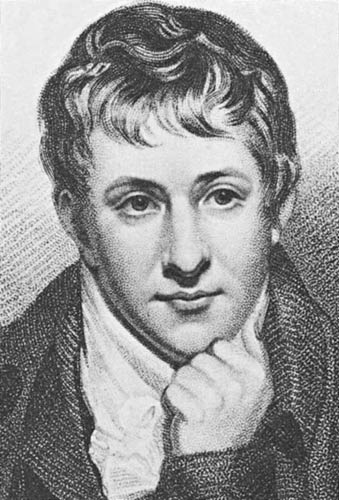 |
| Sir Humphry Davy (1778-1829) |
... at the beginning of 1823...the Navy Board (which provided the Royal Navy's civilian administration) approached Davy about the possibility of protecting the copper sheeting of warships from the corrosive effects of seawater. The naval budget had been reduced by 71.4% since the end of the war of 1815, and hence the Navy Board was seeking to lower expenditures. If the frequency with which ships needed to be dry docked to replace their corroded copper could be reduced, then significant savings would be made.
During 1823, the Navy Board provided Davy with information about copper corrosion and following his return from holiday at the end of October, he began investigating the problem. By mid-January 1824, he concluded that there existed an electrical reaction between the copper and the oxygenated seawater (no corrosion occurred when oxygen was not present) which allowed the formation of various copper salts. Thus he reasoned, that if the electrical polarity between the copper and the seawater was reversed, the corrosion would cease. In his Elements of Chemical Philosophy (1812), he had ranked the electro-chemical reactivities of various metals. Zinc was much more electro-positive than copper-which suggested that a relatively small amount attached to the copper would prevent the corrosion.*
...the Admiralty ordered that practical tests should be carried out on three warships moored in Portsmouth Dockyard. Starting in mid-February 1824. Davy's "protectors" as they were called were attached to their copper, the state of which was monitored in the ensuing months. Faraday, who undertook most of the follow-up experiments, visited Portsmouth once. At the end of April, satisfied that the tests were successful, the Navy Board drafted an order that the entire fleet be fitted with the protectors...and the fitting programme was undertaken during the remainder of the year and into 1825. However...problems began to appear, and by the summer it was clear that the Navy faced a major disaster. Ships returning from the West and East Indies were found to have their bottoms, though preserved, fouled with seaweeds, barnacles, and suchlike. Because of the protectors, no longer were the poisonous salts produced by the corroding copper being released into the water to kill the source of the fouling. Davy...had tried by varying the ratios of protectors to copper to prevent it, but such was the rush and inadequacy of the Portsmouth trials, that...the Admiralty ordered the removal of the protectors.
Then there followed the political task of allocating the blame for the disaster. The Navy Board had protected itself by doing only what the Admiralty ordered. Hence in the eyes of the Admiralty...Davy was to blame. This failure doubtless contributed to Davy's ill health and premature resignation as President of the Royal Society on 6 November 1827.
~Frank A.J.L. James Michael Faraday: A Very Short Introduction, Oxford University Press (2010)
Two years later, Davy was dead at the age of 51.
Thursday, March 24, 2011
"He who lights his taper at mine, receives light without darkening me"
 |
| Original |
From a letter written by Thomas Jefferson to Isaac McPherson:
Monticello, August 13, 1813
...It has been pretended by some, (and in England especially,) that inventors have a natural and exclusive right to their inventions, and not merely for their own lives, but inheritable to their heirs. But while it is a moot question whether the origin of any kind of property is derived from nature at all, it would be singular to admit a natural and even an hereditary right to inventors. It is agreed by those who have seriously considered the subject, that no individual has, of natural right, a separate property in an acre of land, for instance. By an universal law, indeed, whatever, whether fixed or movable, belongs to all men equally and in common, is the property for the moment of him who occupies it, but when he relinquishes the occupation, the property goes with it. Stable ownership is the gift of social law, and is given late in the progress of society. It would be curious then, if an idea, the fugitive fermentation of an individual brain, could, of natural right, be claimed in exclusive and stable property. If nature has made any one thing less susceptible than all others of exclusive property, it is the action of the thinking power called an idea, which an individual may exclusively possess as long as he keeps it to himself; but the moment it is divulged, it forces itself into the possession of every one, and the receiver cannot dispossess himself of it. Its peculiar character, too, is that no one possesses the less, because every other possesses the whole of it. He who receives an idea from me, receives instruction himself without lessening mine; as he who lights his taper at mine, receives light without darkening me. That ideas should freely spread from one to another over the globe, for the moral and mutual instruction of man, and improvement of his condition, seems to have been peculiarly and benevolently designed by nature, when she made them, like fire, expansible over all space, without lessening their density in any point, and like the air in which we breathe, move, and have our physical being, incapable of confinement or exclusive appropriation. Inventions then cannot, in nature, be a subject of property. Society may give an exclusive right to the profits arising from them, as an encouragement to men to pursue ideas which may produce utility, but this may or may not be done, according to the will and convenience of the society, without claim or complaint from anybody. Accordingly, it is a fact, as far as I am informed, that England was, until we copied her, the only country on earth which ever, by a general law, gave a legal right to the exclusive use of an idea. In some other countries it is sometimes done, in a great case, and by a special and personal act, but, generally speaking, other nations have thought that these monopolies produce more embarrassment than advantage to society; and it may be observed that the nations which refuse monopolies of invention, are as fruitful as England in new and useful devices.The Life and Selected Writings of Thomas Jefferson; Koch, A., Peden, W., Eds.; Random House, Inc.: Toronto, 1944
Thursday, February 4, 2010
Über eine neue Art von Strahlung
In the fields of observation chance favors only the prepared mind.
—Louis Pasteur

Wilhelm Conrad Roentgen (1845-1923)
Wilhelm Roentgen (Röntgen for the purists & pronounced sort of like runt-ghen, i.e., with a hard "g") rocked the scientific world when he published Über eine neue Art von Strahlung ("On a new Type of Radiation"). The classic 1896 paper described experiments he had conducted the preceding fall. Just five years later in 1901, Roentgen received the very first Nobel Prize in Physics. The citation recited:
"in recognition of the extraordinary services he has rendered by the discovery of the remarkable rays subsequently named after him."Roentgen didn't want "his" rays to be named after him, and so (in the English-speaking world at least) they are called by the term he coined: X-rays, wherein the "X" stood for "unknown". An account of Roentgen's serendipitous discovery of X-rays is well documented in the Wiki bio linked above. I have a copy of that first paper (in German) published as Chapter 11 in a remarkable book called The German Scientific Heritage by Reginald Phelps & Jack Stein (Copyright 1962 by Holt, Rinehart and Winston, New York). Roentgen wrote in that classic "tall-by-the-brook-standing-tree" syntactical style that seems so uniquely German. Yet Roentgen was an impeccable experimentalist and had already discovered many of the interesting properties of X-rays and set them forth in that first publication. Most astonishing, and perhaps convincing, was his inclusion of the first ever Röntgenbild: an X-ray photograph of his wife's hand, complete with ring:
Hält man die Hand zwischen den Entladungsapparat und den Schirm, so sieht man die dunklen Schatten der Handknochen in dem nur wenig dunkleren Schattenbild der Hand.

Holding the hand between the discharge apparatus and the screen, one sees the darker shadow of the hand bones within the lighter shadow of the hand.
I bring all this up for two reasons: First: heavier atoms in molecules and hence materials are easier to see with X-rays than are lighter ones. Bones are mostly made of calcium, phosphorus and oxygen: the former two elements #20 and #15, are twice as heavy as the "heavy" elements that make up soft tissue, viz., carbon (6), nitrogen (7) and oxygen (8). Hydrogen (1) is the hardest atom of all to see with X-rays. This is also why MRI is such a great complimentary technique to X-rays: it mainly locates (visualizes) hydrogen in water and hydrogen attached to carbon in soft tissues; bones are mostly invisible. Chemists recognize the same complimentarity between X-ray crystallography and NMR spectroscopy. Metals like gold (79) stand out even more sharply by X-ray. Roentgen realized all of this in his now classic paper in which he tested the transparency of various materials.
Another reason to bring this all up is that screening methods at airports have been in the news lately. X-rays are used to screen luggage and people for bombs and contraband. A good primer on their use can be found here. I'm still looking for a good reference on the techniques used for full body scans, especially since the apparent threat of bosom bombers would appear to challenge the current systems and methods in place. Plastic explosives like PETN can be distinguished from silicone breast implants, but apparently not without effort.
Meanwhile, Frau Roentgen is ready for her close-up now:

Thursday, January 7, 2010
Carnot Knowledge: Rudolf Diesel's Awesome Idea

Rudolf Diesel (1858-1913)
Ordinary gasoline engines are powered by the sparked ignition of gasoline vapor compressed with air. The heat of combustion and increased exhaust gas pressure drives pistons, doing useful work derived from the chemical energy stored in the fossil fuel. Gasoline engines behave according to the Otto Cycle and the ideas originally date from the mid-19th century.
Rudolf Diesel, a German engineer, understood the engines of his day and had the radical idea of compressing air inside the piston until it became so hot that fuel would spontaneously ignite when it contacted the hot pressurized air, thus not requiring a spark plug. In essence, Diesel reengineered the existing Otto cycle and invented engines that behaved according to the Diesel Cycle.
Diesel based his ideas on his understanding of the thermodynamics of heat engines, a young science begun by the French engineer Sadi Carnot and who later became known as the father of thermodynamics.
US Patent No. 542,846: "Method of and Apparatus for Converting Heat into Work (Link) was awarded to Diesel and has a clear and concise explanation of how and why diesel motors work. In Diesel's own words (or more likely those of his patent attorney):
The gases in the cylinder are now permitted to expand with gradual introduction of fuel and expansion is so regulated that the decrease in temperature by expansion counterbalances the heat produced by the combustion of the fresh particles of fuel. The effect of combustion will therefore not be increase in temperature or pressure, but increase in actual energy exerted.Diesel also solved another important problem that still limits the efficiency of gasoline engines, viz., the tendency for gasoline motors to knock or ping due to "predetonation." Autoignition is precisely what diesel motors are supposed to do, albeit in a controlled way. In a diesel motor, the air and fuel are pressurized separately and then mixed. Because diesel motors burn at hotter temperatures than gasoline engines do, they have a tendency to "burn air," forming nitrogen oxides from the normally inert N2 and O2 that make up the air we breathe. Precious metal catalysts are used to convert the nitrogen oxides back into oxygen and nitrogen.
Today, diesel motors find widespread use in nearly all commercial transportation applications: trucks, trains, ships, submarines, and, as I learned from Theo Boehm, even in aviation (BTW, did you know that aviation gasoline still has lead? Link--fine particles of lead oxide (or actually lead chloride or bromide) rain down on us everyday. Europeans use diesel motors far more commonly than we do for personal transportation.
I'm sold on diesels. I own a 2003 VW Golf Diesel (TDI) and I love it. It gets around 43 MPH on the highway and not much less in city because it's a stick. Another advantage to owning a diesel in CA is that they are exempt from smog-testing.
Saturday, July 18, 2009
It was all just Rocket Science!


This weekend commemorates the historic trip to the moon by the heroic Apollo 11 astronauts 40 years ago. Let's also pause to remember the passion and drive of the men who designed and built the vehicles that put them there, in particular Dr. Wernher von Braun, designated rocket visionary.
Let's pause and also give thought to the victims of the German V-2 rocket program and to the slaves who died making those rockets under appalling conditions (The V in V-2 stands for Vergeltungswaffe = vengeance weapon). And spare a thought for cranky old Robert Goddard, our own homegrown rocket hero, who at least appeared on a stamp:

I am unconvinced by allegations that the Germans stole secrets from Goddard, having read the account of the V-2 program in Michael Neufeld's excellent The Rocket and the Reich. Neufeld, no fawning acolyte of von Braun, correctly points out that the Germans merely used Goddard's published ideas. In science and technology, success builds upon free and open communication.
The Smithsonian in DC has (or used to have) a collection of scale model rockets lined up side by side, showing the historical progression of rocket design. The models may have even been owned by von Braun himself (first photo above). I don't recall exactly where the collection begins and ends, however, a V-2 rocket stands in the lineup. What struck me then was that there were two V-2's next to each other in the collection: a German one and a V-2 that had been rebranded with American insignia.
Soviet advances in the spring of 1945 halted the V-2 program at Peenemünde. Von Braun and his team relocated to a safer location in the Bavarian Alps while the Third Reich collapsed. On May 2, 1945, with Hitler already dead and Berlin under Soviet control, von Braun surrendered to the Americans. He said later:
We knew that we had created a new means of warfare, and the question as to what nation, to what victorious nation we were willing to entrust this brainchild of ours was a moral decision more than anything else. We wanted to see the world spared another conflict such as Germany had just been through, and we felt that only by surrendering such a weapon to people who are guided by the Bible could such an assurance to the world be best secured.Von Braun and his team, criminally liable in some eyes for the V-2 rocket attacks on European capitals, were given a second chance. Goddard had died in August of 1945 and America needed rocket science. And did we ever get some. Von Braun first headed a secret team located outside of El Paso, TX, where under a sort of house arrest, he and his team reassembed captured V-2 rockets. In 1950, von Braun led the Army's rocket development program team that resulted in the Redstone, the rocket used for the first nuclear ballistic missile. Von Braun and his German wife became naturalized American citizens in 1955.
Von Braun's career really took off after the Soviets launched Sputnik. He was appointed director of the newly created George Marshall Space Flight Center in Huntsville, Alabama. The ballistic missile team, still including many of the old school Peenemünder, all now worked for NASA. And they succeeded splendidly.
My own recollections of the Apollo heydays are still pretty clear. I recall as a boy visiting the Kennedy Space Center in the summer of 1968 on a family vacation to Florida. The giant Saturn V rocket used to launch Apollo 7 was then under construction inside the massive Vehicle Assembly Building . My dad took super 8 mm film of this which I have to just dropped off to convert to digital format. I recall that hot and sweaty Wisconsin day a year later when the moon-landing happened. Relatives were visiting and we cousins had been playing tackle football in the backyard all day. The grown-ups called us inside to watch the historic landing on TV in the cool of the basement.
I also recall seeing von Braun on TV with Walter Cronkite. My memory is fuzzy exactly when that was, but surely it must have been between Apollo missions or perhaps during the long flight time of one of the historic moon missions; von Braun would have been too preoccupied during the take-off and landing phases of each mission to be chatting it up with the avuncular Walter. I do wish I could find that clip on Youtube. Maybe it will turn up as part of a Walter Cronkite retrospective.
Added: Hector at Kiarian Lunch wonders if we will ever go back.
Added much later: Lou Minati linked some really cool old Apollo 11 footage Link
Subscribe to:
Posts (Atom)