Showing posts with label coinage. Show all posts

Friday, November 9, 2012

Nickel and Diming US 'Til Death Do US Part

1913 Indian Head (Buffalo) Nickel, designed by James Earle Fraser.

1913 was an odd year, seeing the introduction of the Buffalo (Indian Head) nickel, and also the ratification of the 16th Amendment which introduced the permanent Federal Income Tax.

I recently finished reading a scholarly paper about the history of the 16th Amendment called "The Ratification Of The Federal Income Tax Amendment" by John D. Buenker.  There's a PDF copy here. The article is old (1980) but still relevant, especially in view of the subsequent Reagan Revolution and the more recent Obama Revanche. I took note of quite a few themes and arguments, because they never seem to go out of style. I want to write something further on this topic and this is just sort of a place keeper.

Friday, July 27, 2012

Engraven Images

If you were a kid of a certain age who collected coins, you might recall that one unattainable possession: the 1909-s V.D.B Lincoln Cent.


The "S" stands for San Francisco where it was minted; the V.D.B. stands for the sculptor's name, Victor David Brenner. When the coin first appeared in 1909 to mark the centennial of Lincoln's birth, it was the first coin to bear the likeness of a real person.  Previously, all U.S. coins had carried the likenesses of stylized subjects like Lady Liberty, Indians, and so forth. Also, previous coin designs had had artist's initials, but VDB's were deemed too ostentatious--or too something--and were moved to the front of coin, just under Lincoln's shoulder, where they still reside. Pull out a penny and have look.

Tuesday, March 20, 2012

Goodbye, Columbium


Christopher Columbus has lost prestige in the New World. First came the historical disputes regarding his claim to priority. But perhaps the most ignominious insult was being downgraded from the Periodic Table.

Finally there's an interesting naming story:
Charles Hatchett's important scientific work was done in the period 1796 to 1806. He was elected a Fellow of the Royal Society in 1797, which is a measure of the esteem in which he was held by his fellow scientists. In 1801 he described in a paper his analysis of a mineral called columbite, named after the location where it had been found in North America. This mineral sample from Massachusetts had lain in the British Museum since 1753. He described the mineral as ".. a heavy black stone with golden streaks ... from Mr. Winthrop": John Winthrop was the first Governor of Connecticut, the source of the mineral. Hatchett showed that the mineral contained a new element and he called it columbium and the mineral columbite, after its place of origin. This year (2001) marks the bicentenary of his discovery. Link
We called Element 41 "columbium" (Cb) for over 150 years until the Euros took it away from us. Van der Krogt:
Element #41 was therefore long known as Niobium as well as Columbium. To end this confusion, at the 15th Conference of the Union of Chemistry in Amsterdam in 1949 the name Niobium was chosen for element #41 and a year later this name was accepted by the International Union of Pure and Applied Chemistry, despite the chronological precedence of the name Columbium. The latter name is still sometimes used in US industry.
Evidence suggests that the Europeans railroaded US out of the name Columbium just to have it for themselves :)

The green color comes from niobium oxide
Niobium is mostly used in steel alloys and for high tech applications. Niobium's use in catalysis plotted versus time looks like a hockey stick: Link  Brazil leads in its production, so in that sense at least, columbium is still New World.

Sunday, March 4, 2012

"A single twig breaks easily but a bundle of twigs is strong"

That saying is attributed to Tecumseh, a Shawnee Indian chief, in the movie "Act of Valor."


I first heard the equivalent of that idea in the David Lynch movie “The Straight Story." Richard Farnsworth says (while demonstrating with sticks):
When my kids were young I played a game with them. I'd give each of them a stick. One for each of 'em, and I'd tell them to break it. They'd do that easy. Then I'd tell them to make one bundle of all the sticks and try to break that. And course they couldn't. I used to say that was family, that bundle.
I tried to extend that familial idea to hydrogen bonds: here

The US "mercury" dimea stunningly gorgeous coin design from the 1930s and 40shad a bundle of sticks on the reverse side:

1936 Mercury Dime designed by Adolph Weinman

The bundle was called a fascia after the old Latin term. I guess the notion of fascia had to be banished from  politics.

Wednesday, November 9, 2011

Hermetically Soiled

The Mercury Dime. The winged cap was supposed to be a Phrygian cap, symbolizing free thought: (footnote 1).  The design also featured a fascia on the reverse which was fitting, considering the time period.

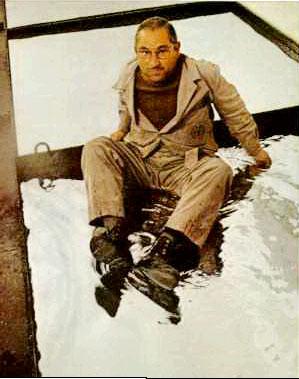
I'm getting way ahead of myself in the Periodic Table, but elemental mercury is such cool stuff.  Here is a photo of a man floating on a vat of mercury, originally published in National Geographic Magazine:


Man floats on mercury
The acute toxicity of elemental mercury is overblown. Mercury is mainly a chronic poison, meaning it takes long term exposure to do serious damage. Mercury compounds--especially methyl mercury--are a different story. I have been slowly ridding myself of silver amalgam filings, but the brain damage may be too late. :)

Mercury has a long medicinal history. Alchemists believed that it had healing powers. When I was a kid, my dad would treat us with what we called "sting medicine." Marketed as mercurochrome, merbromin doesn't actually contain any chromium --rather the name "chrome" refers to the bright reddish orange dye attached to the mercuric ion. The last time I saw or used mercurochrome was in Italy in 1979. I "smuggled" some back, thinking it was a controlled substance. It is still freely--though not widely--available here. The Straight Dope wrote a piece on mercurochrome here: link.

Of course I played around with elemental mercury quite a bit as a chemist.  The most mercury I ever saw in one place was in a Toepler pump, a device which uses a mercury piston to collect and measure non condensable gases like methane and carbon monoxide.

Here's a modern quandary: incandescent bulbs use more watts of power than the newer mercury-containing CFL bulbs. Burning coal emits tons of mercury into the atmosphere. The EPA and others claim that smokestack emissions are not scrubbed link, even though the technology exists. Link

I think it's ironic that we need to disperse mercury in order to rid ourselves of mercury.

Monday, November 7, 2011

Why Does POTUS Mock "In God We Trust"?


The phrase has been on our money since 1864. Why would he mock the continuation of this tradition? Link

Monday, August 29, 2011

Wartime Nickels

Reverse side of a 1942-P Jefferson nickel
While reading and thinking about wartime coinage, I remembered that nickel was also in such short supply during WW II that the mint replaced it with silver. Link  Nickel was needed to harden steel for armor plating. Special nickels were marked with huge mint marks P, D, and S over Monticello on the reverse to facilitate re-collection and melting.  But Gresham's Law kicked in after the war and the silver nickels were hoarded when the price of nickel fell. I still have a few, found in change, darkened with age due to their manganese content.

Lastly, copper was in such short supply during WW II that the Treasury loaned out 14,700 tons of coinage silver for use in making electrical coils for uranium isotope separation at Oak Ridge National Labs. Link

Steelies

The best way to destroy the capitalist system is to debase the currency. -- V.I. Lenin

If we ever get into another full scale shooting war, it's going to cost dearly just to buy all the brass needed to make ammo casings (shells) for bullets.  We've traditionally made them out of brass (copper alloyed with a little zinc).  The Russians and Chinese make their bullet casings out of steel. Because spent cartridges are essentially thrown away on the battlefield, perhaps this is not a bad idea.

We traditionally made pennies out of copper and its alloys: chart  Since 1982, the U.S. Mint has made pennies out of zinc coated with thin layer of copper to keep up appearances. As of 2010, it cost the Mint 1.79 cents to make a penny because of the costs of the penny's materials and production.

As a kid, I used to go to the bank and buy rolls of pennies. Back then (the late 1960's to early '70's) I could still find lots of bronze "wheat pennies" in circulation. I'd comb through change looking to fill those Blue Whitman folders with pennies. Except for the really rare ones, or the pre-WW II ones in good condition, I did all right. Once and a while I'd find a 1943 steel penny.  I could find them easily in a pile of pennies using a magnet. I got 3 or 4 steel pennies that way. I had to buy the "S" one though. Coins minted in San Francisco were always harder to come by east of the Rockies. And the ones I got were never as nice looking as the one in the photo:

1943-s Steel Cent

Wednesday, September 15, 2010

Old World Wisconsin: Freiheit ist Meine!


Revolutions roiled nearly the whole European continent in the late 1840s. Alex de Tocqueville said of that period:
Society was cut in two: those who had nothing united in common envy, and those who had anything united in common terror. link
Wisconsin entered the Union in 1848, just as waves of European emigrants sought new lives. The Revolution of 1848 led to a diaspora of German-speaking peoples, some of whom settled in Wisconsin. They were the intellectual seed for the Wisconsin progressive liberal tradition.

Holmes wrote:
Roughly that segment of the state with Madison as the string center of the arc and with Manitowoc County as the upper swing and South Milwaukee as the lower tangent is densely settled by the descendants of people representing every class and community of German society. The first settlers arrived as early as 1839. Some came seeking religious and civic liberty; others for the purpose of improving their economic and social status. Some were Protestants, others were Catholics and a third group, composed mostly of so-called "Forty-eighters," were "Free Thinkers." Before the migration ended, the Germans were so scattered that their settlements dotting the map of Wisconsin looked like a uniform patch-work quilt.

Scattered among the early German settlers were many so-called "Free Thinkers." At one time this group had twenty-three societies in Wisconsin alone. Mayville had one of the leading organizations. These people were mostly "Forty-Eighters" --men of culture and means. Some had exchanged titles of nobility for their freedom. They were sympathizers with the German Liberal revolution of 1848, and were the progressive liberals of their times.

It is difficult accurately to define their dogma. They were not atheists but they held a belief in some godlike principle of nature. They spoke glibly of their followership after Thomas Paine, French-thinker and American revolutionist. Some had their children baptized in "the name of the United States of America." Often at their gatherings they would display the cap of freedom on the top of the liberty pole. [1]

"Freiheit ist meine!" they shouted.

For eighty years the little village of Thiensville on the old Milwaukee River resisted Christianizing influences.  They had their children married without benefit of clergy. They buried their dead in the old Mequon cemetery under memorials to their name only. Rural neighbors looked askance upon these strange townsmen, calling their community "Little Paris" or the "Godforsaken Village." When a non-conformist newcomer attempted a collection for the founding of a church he was met with a double offer of the amount raised if no church be founded. Repeated efforts to establish a church failed.

At Sauk City remains the last active Freie Gemeinde hall and library in Wisconsin. [2] A spacious lawn and spreading trees give it the imposing setting of a rural community social center. As its members die they are buried in the nearby Free-Thinker cemetery in the Town of Honey Creek.
-Fred L. Holmes, "Freiheit Ist Meine" Old World Wisconsin (1944)
________________________
[1] The seated Liberty on that 1848 quarter in the photo clutches a phrygian cap on a pole.

[2] Wisconsin author August Derleth (1909-1971) associated with the Freie Gemeinde of his beloved "Sac Prairie." Derleth lived, and was buried, in Sauk City.