Showing posts with label copper. Show all posts

Thursday, August 9, 2012

Chimica Arcana

To grasp the invisible elements, to attract them by their material correspondence, to control, purify and transform them by the living power of the spirit, this is true alchemy. 
~Paracelsus (1493-1541)
Before any sort of chemical bonding was even thought of there were charts of so-called affinities.  I found this interesting chart dating from 1718 on Wiki. It teaches how the then-known "elements" combined with each other. The top row identifies an element and the columns contain those elements with which it combines. Note that sulfur (middle column) was considered the most promiscuous element, consistent with its primacy as the "soul" of matter according to alchemy. Also bear in mind that this simple chart condenses the then known science of chemisty, ca. 1718.  I like the arcane symbols and could see using some them as avatars depending on my mood:

Click to enlarge or see link above
______________________
Here are my translations of the "elements."
Esprit acides : Acidic (acerbic) spirits
Acide du sel marin: Lit. acid of sea salt, HCl (which was thought to contain oxygen until Davy showed otherwise: link)
Acide nitreux: Nitric and nitrous acids, HNO3, HNO2
Acide vitriolique: Sulfuric and sulfurous acids, derived from oleum & vitriol.
Sel alcali fixe: Sodium & potassium hydroxides and carbonates.
Sel alcali volatil: Sal ammoniac, NH4Cl, which sublimed and was endlessly fascinating.
Terre absorbante: Silicates (sand) and diatomaceous earth.
Substances metalliques: Metallic substances
Mercure: Mercury was considered to be the spirit of matter.
Regule d'Antimoine: Regulus of antimony--metallic antimony. Regulus means "little King"
Or: Gold
Argent: Silver
Cuivre: Copper
Fer: Iron
Plomb: lead
Etain: Tin
Zinc
Pierre Calaminaire: Lit. calamine stone, i.e., calamine ore. Note the French place name.
Soufre mineral: Sulfur or brimstone.  This material held a special place in alchemy, along with mercury and salt.
Principe huileux ou Soufre: The oily essence of organic substances from plants, also called the "sulfur." See the interesting discussion under Spagyric.
Esprit de vinaigre: Vinegar or acetic acid
Eau: water
Sel: Salt held a special place in alchemy along with mercury and sulfur.  
Esprit de vin et Esprit ardents: Any of the flammable alcohols derived from fermentation, e.g., ethanol, methanol, etc.

Saturday, January 14, 2012

Imagine If You Will, Another Dimension of Atoms...

Cobalt and nickel are elements 27 and 28, respectively, but this wasn't always so. Older textbooks often put cobalt and nickel together because they weren't sure which came first. Though there were chemical reasons to believe that cobalt preceded nickel in the Periodic Table, no matter how carefully they measured it, nickel always came out lighter than cobalt, even though it should be heavier.

Scores of new elements were discovered in the 19th century and back then weight measurements were used to identify them and to place them in the table. T. W. Richards won the Chemistry Nobel in 1914 "in recognition of his exact determinations of the atomic weights of a large number of the chemical elements." But realize that while the Periodic Table originally sorted and arranged chemical elements according to their atomic weights, the table actually sorts the elements according to their atomic numbers. The notion of atomic number was unknown to 19th century chemists.

A hypothetical sample of cobalt, nickel, and copper** ions would give a mass spectrum looking something like this:


Natural cobalt is monoisotopic (59Co), while nickel has five isotopes: 58Ni, 60Ni, 61Ni, 62Ni, and 64Ni, with the lightest being the most abundant. Note how 58Ni precedes 59Co.  Why cobalt likes neutrons more than nickel does is an interesting question for which I have no answer.

Henry Moseley first showed that cobalt and nickel were correctly ordered despite their anomalous weights. Around the same time, J.J. Thompson invented mass spectrometry which sorts ions according to mass as shown above. Thompson discovered that neon had two isotopes but the concept of isotopes wasn't fully understood until James Chadwick discovered the neutron in 1932.  Chadwick's discovery also enabled the subsequent syntheses of elements beyond uranium.
_______________________
*Tellurium (element 52) presents a similar weight anomaly because it is on average heavier than iodine (element 53).
**I wrote about copper isotopes back here and included it because it falls close to Ni and Co.

Thursday, January 12, 2012

Let's take a closer look at those copper atoms


How small can we see? Pretty small, it turns out. We can see atoms (see above)--not with light but with electrons (light is too crude of a yardstick and can't "measure-down" to the job). In Scanning Electron Tunneling Microscopy (STM), a tiny metal wand just an atom or two thick approaches a surface. Electrons, dripping from the tip of the sweeping probe, jump to a surface below, feeding signal back and mapping the atomic topography:

original

Successive traces of electronic signals become a "photo" of the surface. The way STM works reminds me of the spark of life implied so long ago here. The technique is more fully explained here.

Suppose we could zoom a microscope down onto a pure copper surface to find out what's really there. I mean really there there. We'd find, even for ultra pure copper--heterogeneity. What looks the same is really different. No matter where we look, about one in three copper atoms has two "extra" neutrons because native copper comes in two isotopic flavors: 63Cu and 65Cu.

A while back, Michael Haz mentioned that pure copper native to Upper Michigan was distinguishable from pure copper native to South America. It's true. Copper sources have isotopic signatures. The natural ratio of the two copper isotopes varies slightly from place to place for various reasons. The reason(s) why they vary are complex and altogether unimportant here. The point is that they differ and they do so in a way that can be reliably measured--like fingerprints. A similar isotopic method has been used to trace the influx of South American silver into European coinage: link

Monday, November 14, 2011

The SS Great Eastern

I forgot to mention back here about my fascination with the ship which laid most of the first transatlantic cable. Launched in 1858, the SS Great Eastern was the biggest vessel of her day until the White Star Line's RMS Oceanic came along a generation later. Christened the SS Leviathan, she was quickly renamed the Great Eastern and crossed the seas as a passenger vessel, mainly ferrying immigrants to the U.S.

What I find cool about this ship is that she resembles a transition state in the sense that she embodied the past, present, and future of ship propulsion: sails, paddle wheels, and a screw propeller. Of course she was steam drivenDiesel hadn't yet invented his eponymous engine.

The Great Eastern was sold and refitted with several spools of wire-thousands of miles of it. She set about laying wire on the ocean floor between Ireland and Newfoundland and elsewhere around the world. Here's a sketch of what the giant reels of copper wire looked like inside her:

Inside the SS Great Eastern, spooling out copper wire to lay across the ocean floor.

The Great Eastern met a rather ignominious end.  Like the RMS Olympic (older sister of the RMS Titanic), she was scrapped.

Stripped carcass of the SS Great Eastern awaiting the scrapper's torch in 1889.

Wednesday, November 9, 2011

Copper's Special Nature


GOLD is for the mistress--silver for the maid --
Copper for the craftsman cunning at his trade.

from Cold Iron by Rudyard Kipling (1910)
Copper, silver, and gold--we call them coinage metals for obvious reasons. They antedate recorded history because all three were found essentially pure in their uncombined "native" state. Later came smelting and the secrets for winning even more of them from their ores. I once read that around 85 % of all the copper ever mined is still in use.

We had a Copper Age followed by a Bronze Age, during which the metal played a paramount role. But ever since electrification, copper's biggest use has been for wire to conduct electricity. The secrets to copper's utility are its ductility, its conductivity, and its longevity; all three are related to electronics.

Here's a recipe for a metal having high ductility, conductivity, and nobility: Give it a full set of d-orbitals--a resilient layer of 10 perfectly paired electrons surrounding an inner core of 18 perfectly paired electrons (28 in all)--to fend off rapacious oxygen and the harsh world of oxidation. The perfection of copper's 3d subshell adds a sort of resonance like that in the noble gases.

But copper needs one more electron--29 in all. The 29th electron, the outer valence electron, is spherically symmetric. This 29th electron is responsible for copper binding to copper. In theory, just two copper atoms could couple to make a dicopper molecule and it's been studied. But Cu2 is unstable because the bonding is too weak. Instead, the atoms associate into metal.  But there's no directionality to their bonding and the bonds are very weak, lacking covalent character. In a sense, copper is like frozen mercury. This means that copper should easily deform--and so it does. What's more, because each copper atom has a single valence electron, there's room for easily moving electrons; this property translates from metal atoms to bulk metal and copper has an awesome conduction band--thus the conductivity exceeded only by silver for a pure metal.

What about copper's pretty red color? That comes from bathing in visible light. But copper only gives back the reddish portion of the spectrum.

The chemistry of copper is dominated by the chemistry of copper (I), "cuprous ion," from the loss of the 29th electron. But copper can also lose a second electron to make copper (II), "cupric" ion. I once got into an argument over on Althouse over whether copper has one or two valence electrons. Clearly it has two. The word "valence" derives from an atom's combining power and indicates how many electrons an atom can give or take.

What God Hath Wrought, Men First Wrought Of Copper*

I'm always disturbed to hear about copper wire and plumbing being ripped from abandoned and not-so abandoned properties. Thieves are motivated by commodity price inflation, or dollar devaluation--take your pick. It seems like such wanton destruction--an undoing of modern communication and sanitation.  That the copper is probably being recycled and that alternative technologies to copper wire exist for telecommunications, viz., wireless and fiber optics, is small consolation. Those newer technologies bring their own vulnerabilities.

Copper telegraph cable first linked cities beginning around the 1830's. A submarine cable was laid under the English Channel in the 1850's using a continuous length of copper coated with natural rubber. In 1858, the first of several trans-Atlantic cables was laid. A US stamp commemorated the feat:


We may think that we are now safely linked by satellite, but the bulk of Internet communication is still via cable transmission. Not copper, but fiber-optic transmission:


Link to Original
_________________
*The title is a pun/homage to Samuel F.B. Morse's first telegram: "What hath God Wrought?"

Tuesday, November 8, 2011

My Brass Balls


Actually, they're pure copper. Brass is an alloy of copper and zinc.

The Language of Chemistry

Original

Beginning students of chemistry encounter chemical symbols which bear little resemblance to their English names. The roots of several common and especially more historical elements caught my fancy, just as other Latin words buried in English did earlier. link

Several names and symbols come from Latin:
  • Sb stands for antimony which comes from the Latin Stibium. The Italians still call antimony stibio. We did too until the Middle Ages. link
  • Cu for copper comes from Cuprum, which is related to the word Cyprus, an ancient source of copper for the Romans.
  • Fe for iron comes from Ferrum. The Italians call their railroads la ferrovia and Spanish calls hardware ferreteria (cf. bilingual signs at Home Depot). English has the vestigial word, farrier.
  • Au for gold comes from Aurum.  We've lost that word in English except for some pretentious words like aureate, aurelia, aureole and the like.
  • Pb for lead comes from Plumbum. There are lots of English cognates, including plumbago, plumbing, plumb lines and plumb bobs.
  • Hg for mercury comes from hydrargyrum. That's confusing because at first glance it could be water-silver. But "hydra" is more generic and means liquid. Mercury used to be called quicksilver which sort of conveys the same notion as hydrargyrum.
  • Ag for silver comes from Argentum. The French still call money l'argent.
A couple names look like Latin but are neologisms coined by Sir Humphry Davy:
  • K for potassium comes from Kalium which derives from Arabic al-kali.
  • Na for sodium comes from Natrium. The Germans still use both words Natrium and Kalium; they never adopted sodium and potassium. I guess they weren't as impressed with Davy as we were.
Also:
  • Sn for tin comes from the Latin Stannum. There is some irony here.  The word Stannum is Latin but appears to derive from Irish or Welsh. The Romans got their tin from the British Isles.  Tin is still mined in Cornwall.
  • W for Tungsten comes from an older name, Wolfram, which is still used by the Germans. Tungsten derives from Swedish tung heavy + sten stone. 

Monday, November 7, 2011

Why Does POTUS Mock "In God We Trust"?


The phrase has been on our money since 1864. Why would he mock the continuation of this tradition? Link

Wednesday, November 2, 2011

Cu sooner or later?

Garage Mahal sent me this link to a story in the Milwaukee Journal Sentinel. link  A northern Wisconsin stream and ecosystem shows higher than allowable levels of both copper and zinc. At first blush, the circumstantial evidence looks incriminating.  However, the last lines of the story make an important point:

One complicating factor in the dispute is that water quality of Stream C was never tested before mining began, so no baseline exists.
'The fact of the matter is that it flows through an ore body,' the DNR's Fauble said. 'It might just have naturally higher levels of copper in it.'

That region of Wisconsin is rich in copper and other minerals that I wrote about back here concerning the Sudbury Basin. Copper Harbor, MI is not that far away as the glacier flowed. When the first European explorers came to this region, they reported finding nuggets and even small boulders of native copper.  The fact that there's a mine there supports the natural occurrence.

Plants and trees sequester metals like copper and zinc; they also provide a chronological record via rings or even carbon-14.  The answer to the question of whether the abnormally higher levels of copper came sooner or later may be found in the arboreal record.
______________________

Organic sequestration of copper link

Phytoremediation link

[added]
Among the materials in the glacial drift of the Lake Superior Lowland are masses of native copper carried westward by the ice itself and in icebergs. One such mass found near Ontonagon, Michigan, weighs about 3000 pounds, and one from the Bayfield peninsula near La Pointe, Wisconsin, 800 pounds. One of the Jesuit fathers observed in 1669 that there were such bowlder of copper in the Apostle Islands. He relates that the squaws often found copper fragments of 20 to 30 pounds weight in digging holes in the sand to plant their corn, and suggests the transportation of this copper by floating ice, though he did not imply that this was glacial ice.  
Lawrence Martin, The Physical Geography of Wisconsin, 3rd Ed. ; University Of Wisconsin Press: Madison (1965), p. 436.

Monday, August 29, 2011

Wartime Nickels

Reverse side of a 1942-P Jefferson nickel
While reading and thinking about wartime coinage, I remembered that nickel was also in such short supply during WW II that the mint replaced it with silver. Link  Nickel was needed to harden steel for armor plating. Special nickels were marked with huge mint marks P, D, and S over Monticello on the reverse to facilitate re-collection and melting.  But Gresham's Law kicked in after the war and the silver nickels were hoarded when the price of nickel fell. I still have a few, found in change, darkened with age due to their manganese content.

Lastly, copper was in such short supply during WW II that the Treasury loaned out 14,700 tons of coinage silver for use in making electrical coils for uranium isotope separation at Oak Ridge National Labs. Link

Steelies

The best way to destroy the capitalist system is to debase the currency. -- V.I. Lenin

If we ever get into another full scale shooting war, it's going to cost dearly just to buy all the brass needed to make ammo casings (shells) for bullets.  We've traditionally made them out of brass (copper alloyed with a little zinc).  The Russians and Chinese make their bullet casings out of steel. Because spent cartridges are essentially thrown away on the battlefield, perhaps this is not a bad idea.

We traditionally made pennies out of copper and its alloys: chart  Since 1982, the U.S. Mint has made pennies out of zinc coated with thin layer of copper to keep up appearances. As of 2010, it cost the Mint 1.79 cents to make a penny because of the costs of the penny's materials and production.

As a kid, I used to go to the bank and buy rolls of pennies. Back then (the late 1960's to early '70's) I could still find lots of bronze "wheat pennies" in circulation. I'd comb through change looking to fill those Blue Whitman folders with pennies. Except for the really rare ones, or the pre-WW II ones in good condition, I did all right. Once and a while I'd find a 1943 steel penny.  I could find them easily in a pile of pennies using a magnet. I got 3 or 4 steel pennies that way. I had to buy the "S" one though. Coins minted in San Francisco were always harder to come by east of the Rockies. And the ones I got were never as nice looking as the one in the photo:

1943-s Steel Cent

Sunday, August 14, 2011

Cold Iron

GOLD is for the mistress -- silver for the maid --
Copper for the craftsman cunning at his trade.
"Good!" said the Baron, sitting in his hall,
"But Iron -- Cold Iron -- is master of them all."

from Cold Iron by Rudyard Kipling (1910)

Tuesday, April 26, 2011

Sir Davy and the Royal Navy

Fortunately science, like that nature to which it belongs, is neither limited by time nor by space. It belongs to the world, and is of no country and no age. The more we know, the more we feel our ignorance; the more we feel how much remains unknown...
 ~Sir Humphry Davy, November 30, 1825

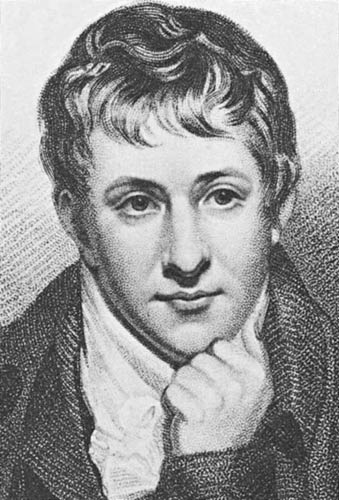
Sir Humphry Davy (1778-1829)
Sir Humphry DavyByronic scientist extraordinaire and mentor to Michael Faraday, scientist plus extraordinaireonce proposed a clever solution to a problem vexing the Royal Navy. But his idea led to unintended consequences. Davy was publicly embarrassed by the Admiralty, and his career never recovered and set the stage for Faraday's rise to the epitome of British science. Sadly, Davy's health also faltered (a possible consequence of chlorine and fluorine gas inhalation). Here's the fascinating story:
 ... at the beginning of 1823...the Navy Board (which provided the Royal Navy's civilian administration) approached Davy about the possibility of protecting the copper sheeting of warships from the corrosive effects of seawater. The naval budget had been reduced by 71.4% since the end of the war of 1815, and hence the Navy Board was seeking to lower expenditures. If the frequency with which ships needed to be dry docked to replace their corroded copper could be reduced, then significant savings would be made.
During 1823, the Navy Board provided Davy with information about copper corrosion and following his return from holiday at the end of October, he began investigating the problem. By mid-January 1824, he concluded that there existed an electrical reaction between the copper and the oxygenated seawater (no corrosion occurred when oxygen was not present) which allowed the formation of various copper salts. Thus he reasoned, that if the electrical polarity between the copper and the seawater was reversed, the corrosion would cease. In his Elements of Chemical Philosophy (1812), he had ranked the electro-chemical reactivities of various metals. Zinc was much more electro-positive than copper-which suggested that a relatively small amount attached to the copper would prevent the corrosion.*
...the Admiralty ordered that practical tests should be carried out on three warships moored in Portsmouth Dockyard. Starting in mid-February 1824. Davy's "protectors" as they were called were attached to their copper, the state of which was monitored in the ensuing months. Faraday, who undertook most of the follow-up experiments, visited Portsmouth once. At the end of April, satisfied that the tests were successful, the Navy Board drafted an order that the entire fleet be fitted with the protectors...and the fitting programme was undertaken during the remainder of the year and into 1825. However...problems began to appear, and by the summer it was clear that the Navy faced a major disaster. Ships returning from the West and East Indies were found to have their bottoms, though preserved, fouled with seaweeds, barnacles, and suchlike. Because of the protectors, no longer were the poisonous salts produced by the corroding copper being released into the water to kill the source of the fouling. Davy...had tried by varying the ratios of protectors to copper to prevent it, but such was the rush and inadequacy of the Portsmouth trials, that...the Admiralty ordered the removal of the protectors.
Then there followed the political task of allocating the blame for the disaster. The Navy Board had protected itself by doing only what the Admiralty ordered. Hence in the eyes of the Admiralty...Davy was to blame. This failure doubtless contributed to Davy's ill health and premature resignation as President of the Royal Society on 6 November 1827.
~Frank A.J.L. James Michael Faraday: A Very Short Introduction, Oxford University Press (2010)

Two years later, Davy was dead at the age of 51.