Showing posts with label Oh The Germanity. Show all posts

Saturday, December 26, 2015

The Last Letter From Stalingrad


[Long time readers of this blog will get what I'm up to again here. Over the past few years, I've rolled out a letter or two from the book "Last Letters  From Stalingrad." This year, I'm bringing the focus back to one in particular: Letter 39 in the series of 39 letters. I got my hands on a German language edition and have tweaked the translation and added footnotes to the original text.]

The following letter is from a young German officer on the front lines in Stalingrad, written to his father in the winter of 1942-43. The letter captures the break in the chain of command in the German General Staff. Before Stalingrad, unbroken generations of German Wehrmacht had defended their country and fought with professional honor (that they were politically betrayed at times is another matter). After Stalingrad, the esprit de corps would never be the same. The whole fighting spirit of the future German Bundeswehr died as well.
Dearest Father:1 
The division has been trimmed down2 for the big battle, but the big battle won't take place. You will wonder why I write to you and in care of your office. But what I have to say in this letter can only be said among men. You will transmit it to Mother in your own way. The word is out that we can write today.3 For one familiar with the situation that means that we can do it just once more.
You are a colonel, my dear Father, and a member of the General Staff.4 So you know what this means, and I needn't go into explanations which might sound sentimental. This is the end. It will last perhaps another week, I think, then the game is up.5 I do not want to look for reasons which one could marshal for or against our situation. The reasons are altogether unimportant and pointless. But if I am to say anything about them, it is this: Do not look to us for an explanation of the situation, but to yourselves and to the man who is responsible for it.6 Don't knuckle under7 --you, Father, and all those who think like you. Be on guard, so that a greater disaster8 does not overtake our country. The hell on the Volga should be a warning to you. I beg you, don't brush off 9 this experience.
And now on to the present. Of the whole division only 69 men are still of use. Bleyer is still alive, and so is Hartlieb. Little Degen lost both his arms; he will probably be in Germany soon. It is also the end for him. Ask him for any details you would like to know. D___ has lost all hope. I would like to know what he is thinking at times of the situation and its consequences. We still have two machine guns and 400 rounds of ammunition. One mortar and ten shells. Besides that, only hunger and fatigue. Without waiting for orders, Berg broke out with twenty men. Better to know in three days how things will end, than in three weeks. Can't blame him.
Finally, on to personal matters. You can be sure that everything will end decently. It is a little early at thirty, I know. No sentiments. Handshake for Lydia and Helene. Kiss for Mother (be careful, old man, think of her heart trouble). Kiss for Gerda, regards to all the rest. Hand to helmet, Father. First Lieutenant ____ respectfully gives notice of departure.
_______________________
The original German has Liebster Vater! The usual way to greet a loved one in German would have been Lieber Vater or "Dear Father."  The author's use of the superlative, Liebster, instead of Lieber, or even Liebester immediately sets a familial tone to the letter.

2 The original has Die Division ist ausgeschlackt... which is much harsher than "trimmed down." Ausgeschlackt (infinitive: ausschlacken) means "cannibalized" or more literally, "butchered out."  The "trimmed down" translation sounds like an obese corps had been made fit; in reality a fit corps had been eviscerated.

3 Originally: Wir dürfen heute schreiben, heißt es bei uns: To us, that means we must write today.

4 Du bist Oberst: Army colonel. His father was a higher-ranked officer, but they were both professional soldiers.

5 The original idiom was: Dann ist der Kragen zu: "then the collar is closed."

6 He's referring to Hitler.

7 Originally, "greater disaster" was written as: Größeres Unheil. "Unheil" seems ironic in view of the well-known Nazi salute.

8 Originally, the idiom "don't knuckle under" was "halten die Nacken stief: keep the neck stiff.
This idiom rhymes with the last two lines of the letter.

9 Originally, the idiom "Don't brush off" was ...schlag deise Erkenntnis nicht in den Wind: don't strike this insight into the wind.
________________________________
A key to understanding this ongoing series is here, and here. Each letter (39 in all) was written by a different and anonymous German soldier who knew he was going to die. I associate these letters with Christmastime for reasons explained at the links.

Friday, April 17, 2015

Words In Drag

A student asked me to prepare a list of German/English cognate verbs; this is useful for building vocabulary. I've been at it for several hours.

Our verb "to drag" is rich in metaphor: dragging something; drag racing; drag queens; take a drag. In English, both verbs "to drag" and "to draw" are closely related.[1] In German, the related verb tragen is more limited: it means to wear, to carry, to bear, and has other supporting roles; they have another word for the basic idea of dragging, ziehen, which means to pull, to drag, to draw, to haul, etc.[2]

Here's the plausible origin of the term "drag race:"
Drag racing (1947), is said to be from thieves' slang drag "automobile" (1935), perhaps ultimately from slang sense of "wagon, buggy" (1755), because a horse would drag it. By 1851 this was transferred to "street," as in the phrase main drag (which some propose as the source of the racing sense). link
There is an old related word "dray" which meant a wagon for hauling stuff; a "drayman" was a "truck driver."

The origin of the term "in drag" is controversial:
Sense of "women's clothing worn by a man" is said to be 1870 theater slang, from the sensation of long skirts trailing on the floor (another guess is Yiddish trogn "to wear," from German tragen); drag queen is from 1941. link
The "dragging on ground" could be related to women's costumes being longer and having trains. The Yiddish origin sounds better, also given that the German word for costume is Tracht which in turn relates back to tragen.

Monday, May 26, 2014

In Memory of the Union

The Memorial Union on the UW-Madison lakeshore opened in the fall of 1928, dedicated to the men and women of the University who had served in wars.

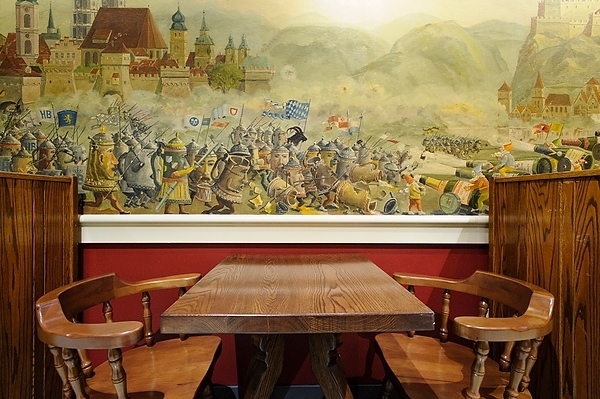
Inside the Student Union, der Rathskeller and der Stiftskeller feature murals done in a German beer hall style. My favorite is the one called "The War Between Wine And Beer"

Original
It's hard to appreciate the detail in that photo. More detailed photos are here. That mural is not that old (1978) and is an inspired copy of the original at Munich's Rathskeller. The fight is not just an imaginary one between beer and wine but also a metaphor for the age-old fight between the wine-loving French and the beer-loving Germans. A history of the murals is here

Sunday, August 11, 2013

What Should Be Forgiven?


Trespasses, sins, guilt, debts, shoulds?

Palladian's version of the Lord's Prayer (evolved from a machine) struck me because of how the words "trespasses" and "trespassed" survived wholly intact:

Or father
court in heaven
shall be dining biking them,
but I will be done
on corporate as it is in heaven
give us this day ordeal the bride
and for guests are trespasses
as a brief for give those who trespassed against its
and leave us not into temptation
to deliver us from evil
for design to step forward
and glory forever,
on and.

The Lord's Prayer has appeared in English since the latter's earliest recorded times but the word "trespass" did not appear until the 16th century. Originally, we used the word gyltas which is cognate with the modern English word "guilt":

Fæder ure þu þe eart on heofonum
si þin nama gehalgod
tobecume þin rice
gewurþe þin willa
on eorðan swa swa on heofonum
urne gedæghwamlican hlaf syle us to dæg
and forgyf us ure gyltas
swa swa we forgyfað urum gyltendum
and ne gelæd þu us on costnunge
ac alys us of yfele soþlice.

By the 14th century, the word had evolved to a combination of dettis and synnys, which are cognate with modern English words "debts" and "sins;" Middle English had clearly felt the influence of the Norman Conquest (1066):


Oure fadir þat art in heuenes halwid be þi name;
þi reume or kyngdom come to be.
Be þi wille don in herþe as it is doun in heuene.
yeue to us today oure eche dayes bred.
And foryeue to us oure dettis þat is oure synnys
As we foryeuen to oure dettouris þat is to men þat han synned in us.
And lede us not into temptacion but delyuere us from euyl.

By the 16th century, "trespasses" had supplanted guilt, sin, and debt to give the verses we know by heart:


Our Father which art in heaven, hallowed be thy name.
Thy kingdom come.
Thy will be done in earth as it is in heaven.
Give us this day our daily bread.
And forgive us our trespasses, as we forgive them that trespass against us.
And lead us not into temptation. But deliver us from evil.
Amen.
___________________
"Trespass" has an archaic meaning of sin or transgression but the word today largely means to stray into another's territory--like being "offsides" -- 5 yard penalty. The OED instructs on the origin of trespass; it is French in origin, meaning to transgress or literally to go beyond. It's odd that we use a word of French origin when the French themselves use the word debit or debt and apparently always have done so: link

The Italians use debito and the Latin Mass uses the identical concept: link

I once wrote a blog post on this topic (which originated in an Althouse comment). There is a curious convolution of monetary debt and sin in the German language (Nietzsche is involved) and I wrote about it here.

[Cross-posted with a question here]

Thursday, August 8, 2013

The Awful Chemical Language

I was often asked to explain chemical nomenclature in the context of such and such intellectual property law matter and one day I surprised a trial lawyer — an elderly gent — with my knowledge. He was actually annoyed at first, perhaps because he felt hostage to knowledge which he did not possess. Actually, he probably just resented that I could bill time for knowledge which I already possessed — just like he could. Had he known what it had cost me to acquire my art, he would also have known that it would break any law firm to buy it. Meanwhile, I had been hard at work learning legal terminology for several weeks, and although I had made good progress, it had been accomplished under great difficulty and annoyance. But he was greatly impressed and after I had explained a while, he said my explanation of the chemical language was very rare, possibly "unique" and he wanted to add me to his litigation team.

Friedrich Wöhler, the father of modern organic chemistry, already remarked in 1835:
Organic chemistry just now is enough to drive one mad. It gives me the impression of a primeval forest full of the most remarkable things, a monstrous and boundless thicket, with no way of escape, into which one may well dread to enter.
A person who has not studied chemistry — especially organic chemistry — can form no idea of what a perplexing language describes that thicket. Or perhaps they can, but can come up with no logical explanation for why things are so. I aim here to simplify.

The Germans invented modern organic chemistry and they logically fashioned the nomenclature in their own image — and just as the German language is troublesome for the beginner — having so many parts of speech — it's no wonder organic nomenclature is so troublesome.

An average organic chemical name is a sublime and impressive curiosity; it may occupy several lines and comprise several unfamiliar names and numbers — things called moieties — and even Greek letters; it is built mainly of compound words synthesized by the writer around a core or parent name; it's quite often a word not to be found in any normal dictionary — several words compacted into one, but with joints and seams — that is, with hyphens; it may treat of up to umpteen different subunits, each enclosed in a parenthesis of its own, with here and there extra parentheses which reinclose three or four of the minor parentheses, making pens within pens: finally, all the parentheses and re-parentheses are massed together between a couple of king-parentheses, one of which is placed in the first line of the majestic structure and the other in the middle of the last line of it — after which comes the parent compound name, and you find out for the first time what the molecule is or at least what some chemical lexicographer thought it should be derived from. Sometimes, often as an afterthought — merely by way of differentiation — the writer shovels in the name of a salt, or in patent parlance "or salts thereof," signifying that the delicate molecular flower has been preserved as a salt, and the monument is finished. I suppose that this closing hurrah is often the doing of patent attorneys seeking to claim more broadly; it's not necessary, but covers the doctrine of equivalents.

To repeat, organic chemistry nomenclature was invented by 19th century Germans who wanted to create a simple system which closely mimicked the logic of their own language. Full stop. Therein lies the secret why that nomenclature is so seemingly obtuse — it is patterned after German syntax. In linguistics, syntax refers to the way in which morphemes are arranged. By analogy, "chemical morphemes" are irreducible units of metaphor — core words like "meth-," eth-," "prop-," and "but-" and ringed ones like "phen-" or "benz-" represent chemical entities. [1]  The studied reader may already recognize these morphemes in methane, ethane, propane, butane, phenyl, and benzene and the like. The endings "ane," "yl," and "ene" are, in a linguistic sense, inflections of the morphemes. Another word related to morphemes commonly used by chemists is moiety. Moiety refers to small clusters of recognizable function, for example, "acyl," carboxyl," "alkyl," etc.

By way of example, consider the common pain reliever ibuprofen which more properly goes by the name
RS-2-(4-(2-methylpropyl)phenyl)propanoic acid.

Chemical names are easier to read when you hold them next to the actual structure which is like a pictograph (hold that thought for later) or read them backwards in a mirror or stand on your head — so as to reverse the construction -- but because many refuse to learn the real language of chemistry — structural short hand — I'll muddle through the name of ibuprofen by way of example.  It's not a particularly elaborate molecule or name, but it strikes a nice balance between complexity and simplicity.

R,S-2-(4-(2-methylpropyl)phenyl)propanoic acid

First comes "R,S." The "R" stands for rectus (Latin for right) and the "S" stands for sinister (Latin for left). This gives the enlightened reader notice that chirality is at hand — more on this later.

R,S-2-(4-(2-methylpropyl)phenyl)propanoic acid

The second element in the name is the number 2, and because this number stands alone — outside of parentheses — the reader is asked to hold its meaning in abeyance until such a time as the parent morpheme is finally reached after much exhaustion of patience. Putting the "2" in front resembles the dreaded separable prefix verbs so common to German. Mark Twain wrote in his delightful essay, The Awful German Language:
The Germans have another kind of parenthesis, which they make by splitting a verb in two and putting half of it at the beginning of an exciting chapter and the other half at the end of it. Can any one conceive of anything more confusing than that? These things are called "separable verbs." The German grammar is blistered all over with separable verbs; and the wider the two portions of one of them are spread apart, the better the author of the crime is pleased with his performance.
R,S-2-(4-(2-methylpropyl)phenyl)propanoic acid

The third element, (4-(2-methylpropyl)phenyl) is a microcosm of the whole name writ larger; in it we have a 2-methylpropyl corralled by parentheses, which is itself corralled by "4-" and "phenyl." The name is starting to look like a matryoshka doll.

R,S-2-(4-(2-methylpropyl)phenyl)propanoic acid

At long last we arrive at the parent morpheme, which like the verb in a German sentence, tells us the key information: propanoic acid. In the lexicographer's mind, ibuprofen is a derivative of propanoic acid.

We have the germanic parenthesis disease in our language, too; also often expressed with em dashes and sometimes elipses and one may see cases of it every day in our books and blog posts: but with us it is — unless botched — the mark and sign of a practiced writer or a clear intellect, whereas with the Germans and chemical lexicographers it is doubtless the mark and sign of a practiced pen and of the presence of that sort of luminous intellectual fog which stands for clearness among these people. For surely it is not clearness — it necessarily can't be clearness.

Now dear reader, allow me to introduce a better way to depict all the foregoing and to illustrate the  foolishness:
Ibuprofen
R,S-2-(4-(2-methylpropyl)phenyl)propanoic acid

I have color-coded the three main parts of the molecule, both in name and in the depiction. The reader immediately grasps that the red propanoic acid portion has a three carbon chain. The red number "2" in the name describes wherefrom the rest depends. The "R,S" refers to the two possible ways that the invisible hydrogen atom attached to carbon 2 may point: either out of or into to the screen or page. The portion circled in light blue is a phenyl moiety having six carbons numbered as shown. The curious reader can attest that the portion in green indeed appends from carbon 4 of the blue phenyl. The left-most portion — circled in green — is the "2-methylpropyl" portion: it's really a 3-carbon propyl chain having a methyl affixed to carbon 2.

Lastly, it is perhaps now apparent (to me at least) where the trivial name ibuprofen comes from: I parse ibuprofen into three separable pieces: ibu/pro/fen

"ibu" is short for "isobutyl (another name for 2-methylpropyl;"
"pro" is short for "propanoic acid;"
"fen" stands for "phenyl."

Have you got a headache yet?
________________________
Suggested further reading:

[1] An Algorithm For Translating Chemical Names To Molecular Formulas
[2] Development Of Systematic Names For The Simple Alkanes

Monday, December 17, 2012

Das Sturmgewehr!

(I haven't done a gun-related post in a while but there are ten of them here, all nested under the "guns" tag)

The assault rifle is under assault again, despite its minimal actual involvement in heinous domestic crime. I think I know why it's targeted: it's got a hellacious moniker which actually traces back to Adolf Hitler. He named the novel weapon das Sturmgewehr (the assault rifle). The original assault rifle had the defining characteristics: light weight, medium cartridge size, & short range. The original Sturmgewehr was both semi- and fully automatic.

Here's a short video on the history of das Sturmgewehr:


Automatic weapons are illegal in most states.  Not in Nevada.  I fired a Thompson (Tommy gun) in Las Vegas and my son shot an MP5 last year.

Sunday, December 9, 2012

Perhaps The Sun Will Shine Again Tomorrow*


Vielleicht Scheint Morgen Die Sonne Wieder* by Werner Stelly is a beautiful short story I first encountered in a college German class. It was in a book called Lebendige Literatur. Here is the opening paragraph (my translation):
When the young man went up the stairs, the sun was shining through the colorful windows. Every time the sun was out and the young man came home in the afternoon, he saw the bright reflection of the window on the wall, and he thought how happy they could be. And a warm feeling flowed with his blood to his heart. Flecks of red, blue and green light scattered on the wall of the staircase landing, and he was almost cheerful, happy and satisfied.
The story continues, telling of the young man's wife and their son, all of whom show disparate feelings--anger, sadness, and hope--yet gather each day for their daily rituals. In the end, the father hopes that his son will one day too see the same beautiful resolution of sunlight on the wall.

Here is the original German:
Als der junge Mann die Treppen hinauf ging, schien die Sonne durch die bunten Fensterscheiben. Jedesmal, wenn die Sonne schien und der junge Mann am Nachmittag, wenn er nach Hause kam, den bunten Widerschein der Fenster an der Wand sah, dachte er, wie glücklick sie sein könnten. Und ein warmes Gefühl strömte ihm mit dem Blut zum Herzen. Ein paar rote, blaue und grüne Flecke an der Wand des Treppenhauses machten, daß er beinahe heiter, glücklich und zufrieden wurde.    
A string of 11 German words, all having English cognates, struck me the first time I read them back then:
Und ein warmes Gefühl strömte ihm mit dem Blut zum Herzen
I parsed that sentence, making each word a clickable link.

George Orwell wrote in Politics And The English Language:
Now analyze these two sentences a little more closely. The first contains forty-nine words but only sixty syllables, and all its words are those of everyday life. The second contains thirty-eight words of ninety syllables: eighteen of those words are from Latin roots, and one from Greek. The first sentence contains six vivid images, and only one phrase ('time and chance') that could be called vague. The second contains not a single fresh, arresting phrase, and in spite of its ninety syllables it gives only a shortened version of the meaning contained in the first. Yet without a doubt it is the second kind of sentence that is gaining ground in modern English. I do not want to exaggerate. This kind of writing is not yet universal, and outcrops of simplicity will occur here and there in the worst-written page. Still, if you or I were told to write a few lines on the uncertainty of human fortunes, we should probably come much nearer to my imaginary sentence than to the one from Ecclesiastes.
Orwell was writing about bad writing in English, not translating. But the same lesson holds. Some words have ordinary meanings deeply rooted in the past. But some ideas will not translate literally, like "a pair of three color stains on the wall" in Stelly's story. But others remain unchanged through time and across languages.

Monday, November 19, 2012

The Parable Of The Doorkeeper*


Franz Kafka (1915):
Before the law sits a gatekeeper. To this gatekeeper comes a man from the country who asks to gain entry into the law. But the gatekeeper says that he cannot grant him entry at the moment. The man thinks about it and then asks if he will be allowed to come in sometime later on. “It is possible,” says the gatekeeper, “but not now.” The gate to the law stands open, as always, and the gatekeeper walks to the side, so the man bends over in order to see through the gate into the inside. When the gatekeeper notices that, he laughs and says: “If it tempts you so much, try going inside in spite of my prohibition. But take note. I am powerful. And I am only the gatekeeper. But from room to room stand gatekeepers, each more powerful than the other. I cannot endure even one glimpse of the third.” The man from the country has not expected such difficulties: the law should always be accessible for everyone, he thinks, but as he now looks more closely at the gatekeeper in his fur coat, at his large pointed nose and his long, thin, black Tartar’s beard, he decides that it would be better to wait until he gets permission to go inside. The gatekeeper gives him a stool and allows him to sit down at the side in front of the gate. There he sits for days and years. He makes many attempts to be let in, and he wears the gatekeeper out with his requests. The gatekeeper often interrogates him briefly, questioning him about his homeland and many other things, but they are indifferent questions, the kind great men put, and at the end he always tells him once more that he cannot let him inside yet. The man, who has equipped himself with many things for his journey, spends everything, no matter how valuable, to win over the gatekeeper. The latter takes it all but, as he does so, says, “I am taking this only so that you do not think you have failed to do anything.” During the many years the man observes the gatekeeper almost continuously. He forgets the other gatekeepers, and this first one seems to him the only obstacle for entry into the law. He curses the unlucky circumstance, in the first years thoughtlessly and out loud; later, as he grows old, he only mumbles to himself. He becomes childish and, since in the long years studying the gatekeeper he has also come to know the fleas in his fur collar, he even asks the fleas to help him persuade the gatekeeper. Finally his eyesight grows weak, and he does not know whether things are really darker around him or whether his eyes are merely deceiving him. But he recognizes now in the darkness an illumination which breaks inextinguishably out of the gateway to the law. Now he no longer has much time to live. Before his death he gathers in his head all his experiences of the entire time up into one question which he has not yet put to the gatekeeper. He waves to him, since he can no longer lift up his stiffening body. The gatekeeper has to bend way down to him, for the great difference has changed things considerably to the disadvantage of the man. “What do you still want to know now?” asks the gatekeeper. “You are insatiable.” “Everyone strives after the law,” says the man, “so how is it that in these many years no one except me has requested entry?” The gatekeeper sees that the man is already dying and, in order to reach his diminishing sense of hearing, he shouts at him, “Here no one else can gain entry, since this entrance was assigned only to you. I’m going now to close it."

The original:
Vor Dem Gesetz

Vor dem Gesetz steht ein Türhüter. Zu diesem Türhüter kommt ein Mann vom Lande und bittet um Eintritt in das Gesetz. Aber der Türhüter sagt, daß er ihm jetzt den Eintritt nicht gewähren könne. Der Mann überlegt und fragt dann, ob er also später werde eintreten dürfen. »Es ist möglich«, sagt der Türhüter, »jetzt aber nicht.« Da das Tor zum Gesetz offensteht wie immer und der Türhüter beiseite tritt, bückt sich der Mann, um durch das Tor in das Innere zu sehn. Als der Türhüter das merkt, lacht er und sagt: »Wenn es dich so lockt, versuche es doch, trotz meines Verbotes hineinzugehn. Merke aber: Ich bin mächtig. Und ich bin nur der unterste Türhüter. Von Saal zu Saal stehn aber Türhüter, einer mächtiger als der andere. Schon den Anblick des dritten kann nicht einmal ich mehr ertragen.« Solche Schwierigkeiten hat der Mann vom Lande nicht erwartet; das Gesetz soll doch jedem und immer zugänglich sein, denkt er, aber als er jetzt den Türhüter in seinem Pelzmantel genauer ansieht, seine große Spitznase, den langen, dünnen, schwarzen tatarischen Bart, entschließt er sich, doch lieber zu warten, bis er die Erlaubnis zum Eintritt bekommt. Der Türhüter gibt ihm einen Schemel und läßt ihn seitwärts von der Tür sich niedersetzen. Dort sitzt er Tage und Jahre. Er macht viele Versuche, eingelassen zu werden, und ermüdet den Türhüter durch seine Bitten. Der Türhüter stellt öfters kleine Verhöre mit ihm an, fragt ihn über seine Heimat aus und nach vielem andern, es sind aber teilnahmslose Fragen, wie sie große Herren stellen, und zum Schlusse sagt er ihm immer wieder, daß er ihn noch nicht einlassen könne. Der Mann, der sich für seine Reise mit vielem ausgerüstet hat, verwendet alles, und sei es noch so wertvoll, um den Türhüter zu bestechen. Dieser nimmt zwar alles an, aber sagt dabei: »Ich nehme es nur an, damit du nicht glaubst, etwas versäumt zu haben.« Während der vielen Jahre beobachtet der Mann den Türhüter fast ununterbrochen. Er vergißt die andern Türhüter, und dieser erste scheint ihm das einzige Hindernis für den Eintritt in das Gesetz. Er verflucht den unglücklichen Zufall, in den ersten Jahren rücksichtslos und laut, später, als er alt wird, brummt er nur noch vor sich hin. Er wird kindisch, und, da er in dem jahrelangen Studium des Türhüters auch die Flöhe in seinem Pelzkragen erkannt hat, bittet er auch die Flöhe, ihm zu helfen und den Türhüter umzustimmen. Schließlich wird sein Augenlicht schwach, und er weiß nicht, ob es um ihn wirklich dunkler wird, oder ob ihn nur seine Augen täuschen. Wohl aber erkennt er jetzt im Dunkel einen Glanz, der unverlöschlich aus der Türe des Gesetzes bricht. Nun lebt er nicht mehr lange. Vor seinem Tode sammeln sich in seinem Kopfe alle Erfahrungen der ganzen Zeit zu einer Frage, die er bisher an den Türhüter noch nicht gestellt hat. Er winkt ihm zu, da er seinen erstartenden Körper nicht mehr aufrichten kann Der Türhüter muß sich tief zu ihm hinunterneigen, denn der Größenunterschied hat sich sehr zuungunsten des Mannes verändert. »Was willst du denn jetzt noch wissen?« fragt der Türhüter, »du bist unersättlich.« »Alle streben doch nach dem Gesetz«, sagt der Mann, »wieso kommt es, daß in den vielen Jahren niemand außer mir Einlaß verlangt hat?« Der Türhüter erkennt, daß der Mann schon an seinem Ende ist, und, um sein vergehendes Gehör noch zu erreichen, brüllt er ihn an: »Hier konnte niemand sonst Einlaß erhalten, denn dieser Eingang war nur für dich bestimmt. Ich gehe jetzt und schließe ihn.«
_________________________
*Doorkeeper or gatekeeper?  The original German is Türhüter, a compound word meaning door + guard.** German has two words Tür and Tor which mean door and gate, respectively. Both stem from the same root and are obviously cognate with "door." Kafka would have used doorkeeper instead of gatekeeper, but the metaphorical gatekeeper is more entrenched in English.

**hüter is cognate with the English word/concept "to heed."

Wednesday, October 10, 2012

Bremsstrahlung

Glenn Reynolds pulled a different quote from this story on electric cars: link

I liked this one because it reminded me of how fuel taxes act like brakes:
If you’ve ever ridden in a Prius, you may have noticed that it creeps forward when you take your foot off the brake.
Also, Bremsstrahlung is such a cool word/concept that I wanted to put it out there.

Wednesday, August 15, 2012

Friday, August 10, 2012

Pure Enjoyment

Consider all the English words based around the Greek word logos--derived words like catalog, prologue, dialogue, logogram, zoology, even blog...it's a root word with countless derivatives. Logos is to words what the substance purine is to the chemistry of life.

Purine is ubiquitous and underlies a great deal of biochemistry. It, along with the even simpler pyrimidine, are the core base pairs in DNA and RNA. Purine is also the basis for a surprising number of familiar Genußmittel--things like caffeine and theobromine (the stimulant in chocolate). The German word Genußmittel is bit like Schadenfreude and has no literal equivalent--the best translation is perhaps "means of enjoyment."  Our own English word (which the French also use) is stimulant.


Of course, purines are not everything--there are also sugars, and amino acids too, which are completely different entities.  Diversity. But we owe our first taste of purine, and the apt name, to a German chemist named Emil Fischer.

Tuesday, July 3, 2012

The First Quantum Mechanic


Max Planck was the first quantum mechanic.  He began as an "old school" mechanic, thoroughly steeped in Newtonian mechanics and Maxwell's electrodynamics; those laws conveniently sorted physics into the "corpuscular" and the "ethereal" domains, a dichotomy that corresponded to things having mass and things lacking mass, i.e., radiant light. Higgs had something to say about this later.

Isaac Newton had solved the age-old riddle of why apples fall, allowing astronomers to predict the motions of the heavens. Miracle, mystery and authority. Newton also dabbled in light, describing reflection and interference--along with his famous prism experiments--but the mathematical laws governing light propagating "through the ether" were first described by a Scotsman, James Clerk Maxwell. Newton's Laws of Gravitation governed masses while Maxwell's electrodynamics ruled the waves. Planck came along in 1900 and sort of melded the two theories at their interface.

Physics then had a big unsolved problem called "black body radiation." Heating kilns and ovens made the inside walls glow--first red, then yellow, and finally white hot. Glass makers and potters could even gauge an oven's temperature based on its color inside. Adding more heat to an oven made the walls give off progressively higher energy light but there was a limit: ovens would not begin to emit UV light. Light bulbs were another 19th century invention that used heat (electrical resistance) to produce light and Planck was motivated in part by practical concerns.

What Planck did can be summarized visually with a plot of light intensity versus wavelength:


Planck's theoretical curves (berechnet) agreed beautifully with experiment (beobachtet). Note that there are seven different non-overlapping curves corresponding to progressively higher temperatures. Prior attempts to predict the same phenomenon, based on classical electrodynamics, had failed. These attempts are neatly summarized in this graphic:


The green line corresponds to Planck's law and to reality; the red line, Rayleigh-Jeans Law, only worked at low frequencies (long wavelengths), while the blue line, Wien's Law, worked only at the high frequencies (short wavelengths).  As an aside, the red line's straight up ascent was later referred to as the "Ultraviolet Catastrophe" as a sort of metaphor for the failure of classical theory to account for the reality of Planck's Law. But Planck did more than meld two theories--he invented anew.

The newer science of thermodynamics and Maxwell Boltzmann in particular had shown that tiny invisible yet indivisible atoms could statistically sum to bulk properties. The details are grounded in probabilities rather than certainties, much like my Parable Of The Gas. What Planck did was to apply Boltzmann-like statistical mechanics to the problem of black body radiation.

Planck viewed a red-hot oven (black body radiator) as material in equilibrium with light--sort of a transubstantiation of the ethereal and corpuscular. He named the nexus--the unseen--"resonators" and counted them in a statistical way, describing their behavior mathematically. This was all well before anyone knew or even thought that atoms were held together by electrons--atoms were still thought to be amorphous blobs. That something as seemingly seamless as light should be treated like discrete masses when it interacted with matter was an assumption but it proved key to deriving the solution to the black body problem. There was no other way to explain the behavior. What Planck did was revolutionary, but he did not do it because he understood why--he did it because his theory fit experiment. Werner Heisenberg later stated Planck's insight most succinctly and in most certain terms:
Radiant heat is not a continuous flow and indefinitely divisible. It must be defined as a discontinuous mass made up of units all of which are similar to one another. 
Around the time of Planck's insight, another, younger German physicist appeared on stage. He was then a Swiss patent examiner and barely known, preoccupied with developing his own theories of relativity, but his elastic mind intuitively wrapped around what even Planck had trouble fully accepting and generalizing.  Einstein took Planck's teachings and explained the photoelectric effect--why blue light but not red light could make certain metals conduct electricity. It seemed counter intuitive that even the most intense red light could not do what the faintest of blue light could do. Einstein explained that only blue light was energetic enough to knock electrons free. There were energy thresholds and band gaps at the atomic level. Discontinuities and E=hv.

According to Thomas Kuhn, Planck needed the goading of Einstein and Paul Ehrenfast afterwards to fully realize what he had done. Certainly Planck's older contemporaries were doubters too. In Planck's words:
A new scientific truth does not triumph by convincing its opponents and making them see the light, but rather because its opponents eventually die, and a new generation grows up that is familiar with it.
Planck and Einstein remained close friends throughout the 1930's. Planck, conservative Christian, and Einstein, agnostic Jew, enjoyed making music together when not discussing physics in Wilhelmine and Weimar Berlin--while it lasted (maybe they did discuss the physics of music--frequencies, harmonics, metered beats). Planck tried in vain to intervene on his friend's behalf during the rise of the Nazi regime but he ultimately failed.

There was even greater sadness for Planck besides the exile of his great friend Einstein; there was the trial of his eldest son Erwin at the hands of Roland Freisler, whom I described back here. The Nazis executed Erwin Planck just a few heartbreaking months before the whole regime finally collapsed. The older Planck never recovered from the loss of Erwin and died just two years later in 1947. Here they are during happier times:

Max and son Erwin Planck
Erwin Planck on trial for his life before the People's Court, arrested and charged as part of the July conspiracy to assassinate Hitler:

Erwin Planck vor dem Gesezt in 1945
Erwin Planck, like so many others, was only involved in aftermath planning--helping to draft a post-Hitler German Constitution--and not the actual assassination plot.

The elder Planck's life sort of tracked a shape: A half-century of slow triumph peaked in the 1930's and then precipitously declined, much like the shape of one of his triumphant black body radiation curves which conquered physics. Post-war Germany honored Planck by renaming the Kaiser-Wilhelm-Gesellschaft (its premier scientific society) the Max-Planck-Gesellschaft.


Thursday, March 29, 2012

The Frightening News First Heard In German...

Lise Meitner with Otto Hahn. Leitner, who was born Jewish, had fled Berlin that July 1938. She first spread the news of fission to the rest of the physics community.
Splitting the atom in 1938 was something wholly different than what had gone on with radiation since its discovery in 1896. To my mind, the news must have been like expanding the notion of arithmetic from simple addition and subtraction to suddenly include the concept of division. It really blew people's minds at the time. Soddy had explained how elements incrementally transmuted downwards in atomic number (subtraction) by shedding alpha particles and how they transmuted upwards (addition) in number by losing beta particles, but nobody was looking for this:*

original
In 1938, Otto Hahn and Fritz Straßmann bombarded uranium with neutrons and fished out the products. Neutrons were all the rage after their discovery in 1932 and physicists wanted to know what they did to all types of matter. Enrico Fermi had started this sort of work in Italy, but had been interrupted. It was only a matter of time before someone figured out what was going on. Hahn and Straßmann had expected to observe slightly lighter atoms like radium, actinium, and thorium; instead they observed the much lighter elements barium, lanthanum, and cerium:
Als Chemiker müssen wir aus den kurz dargelegten Versuchen das obengebrachte Schema eigentlich umbenennen und statt Ra, Ac, Th die Symbole Ba, La und Ce einsetzen. Als der Physik in gewisser Weise nahestehende Kernchemiker können wir uns zu diesem, allen bisherigen Erfahrungen der Kernphysik widersprechenden Sprung noch nicht entschließen. Es könnte doch noch vielleicht eine Reihe seltsamer Zufälle unsere Ergebnisse vorgetäuscht haben.
As chemists, we must rename [our] scheme and insert the symbols Ba, La, Ce in place of Ra, Ac, Th. As nuclear chemists closely associated with physics, we cannot yet convince ourselves to make this leap, which contradicts all previous experience in nuclear physics. A series of strange coincidences could still prove our results false.
This was the first published account of nuclear fission. Smart people realized that the exact chemical products required that more neutrons were coming out than were going in--this was soon verified and led physicists to realize that Leo Szilárd's chain reaction was now feasable. The news spread like fallout. And because it came from 1938 Berlin, the entire rest of the physics community panicked...and then they organized.**

Read more about the discovery of fission here.


__________________________
*A German chemist, Ida Noddack, had suggested as early as 1934 that "it is conceivable that the nucleus breaks up into several large fragments, which would of course be isotopes of known elements but would not be neighbors of the irradiated element"---but no one took her seriously.  link

**Another frightening fact was that the Austrians had cut off everyone else's supply of uranium from the original Czech mine--the same place Marie Curie had obtained her original samples in 1896.

Wednesday, February 22, 2012

The Restless Conscience


I found this movie on Netflix and watched it last weekend.  I wanted to see and hear Freya von Moltke, whom I wrote about here. She appears briefly in the linked trailer at the 1 min 14 sec mark. She is interviewed throughout the movie which tells the story of her husband, Helmuth James von Moltke, whom I wrote about here. The movie isn't about him per se but does an excellent job of fitting him into the larger picture of German anti-War resistance at the time.

If you're into that sort of history, give the movie a watch.  The Restless Conscience (1992)

Monday, January 16, 2012

Tuesday, December 27, 2011

Mittbestimmung

Mittbestimmung:  noun. The determination of Mitt Romney to become president. An English-German portmanteau word derived from Mitt + Bestimmung. Also a riff on Mitbestimmung, with reference to Romney's participation in government.

Friday, November 11, 2011

Letters From Their Eleventh Hour: Wilhelm Wolter (1895-1915)

WILHELM WOLTER
Student of Philosophy, University of Munich

Born May 28th, 1895, at Kladow, Mecklenburg.
Killed April 16th, 1915, near Vouziers, France

Just shy of his 20th birthday, the teenaged Wolter asks (his parents? a friend? a teacher? us? God?) whether it is fair that a young man should die for a higher cause before having had time to give anything back. Wolter wrote that he had a mission in life--"a message to deliver:"


Letters From Their Eleventh Hour: Eduard Bruhn (1890-1915)

EDUARD BRUHN,
Student of Theology, Kiel

Born October 18th, 1890, at Schlamersdorf.
Killed September 17th, 1915, in Russia.

Bruhn writes (or dictates) his last letter:

Monday, October 31, 2011

Der Erlkönig: A Halloween Poem


My recitation of Goethe's poem, Der Erlkönig:


Here is the original text: link
Wer reitet so spät durch Nacht und Wind?
Es ist der Vater mit seinem Kind;
Er hat den Knaben wohl in dem Arm,
Er faßt ihn sicher, er hält ihn warm. 
"Mein Sohn, was birgst du so bang dein Gesicht?" —
"Siehst, Vater, du den Erlkönig nicht?
Den Erlenkönig mit Kron und Schweif?" —
"Mein Sohn, es ist ein Nebelstreif." 
"Du liebes Kind, komm, geh mit mir!
Gar schöne Spiele spiel' ich mit dir;
Manch' bunte Blumen sind an dem Strand,
Meine Mutter hat manch gülden Gewand." — 
"Mein Vater, mein Vater, und hörest du nicht,
Was Erlenkönig mir leise verspricht?" —
"Sei ruhig, bleibe ruhig, mein Kind;
In dürren Blättern säuselt der Wind." — 
"Willst, feiner Knabe, du mit mir gehen?
Meine Töchter sollen dich warten schön;
Meine Töchter führen den nächtlichen Reihn,
Und wiegen und tanzen und singen dich ein." — 
"Mein Vater, mein Vater, und siehst du nicht dort
Erlkönigs Töchter am düstern Ort?" —
"Mein Sohn, mein Sohn, ich seh es genau:
Es scheinen die alten Weiden so grau. —" 
"Ich liebe dich, mich reizt deine schöne Gestalt;
Und bist du nicht willig, so brauch ich Gewalt." —
"Mein Vater, mein Vater, jetzt faßt er mich an!
Erlkönig hat mir ein Leids getan!" — 
Dem Vater grauset's, er reitet geschwind,
Er hält in Armen das ächzende Kind,
Erreicht den Hof mit Müh' und Not;
In seinen Armen das Kind war tot.

~Johann Wolfgang von Goethe

Thursday, September 1, 2011

How Freud's "Ich Factor" got lost in translation

When Sigmund Freud invented and first wrote about the Id, the Ego, and the Super-Ego, he used the German language terms: das Es, das Ich, and das Über-Ich.  German speakers will instantly recognize the corresponding pronoun parts of speech. This point has been made before: link.

When I thought about Freud's constructs as a sketch, I discovered it had been done already (of course):


original

In that scheme, das Ich (Ego) encircles an inchoate Es (Id). Each individual* Ich is in turn surrounded by a larger circle, "the Environment" (super-ego).

More often, Freudian constructs are sketched as an iceberg, for example:

original

I like the circles sketch better. Stretching the notion, the political constructs of individuals, states, nations, and supra-national entities fit an expanded "circles of circles" diagram and also help explain my father's favorite dictum:
If people can't control themselves, the government will. If the government can't control itself, another government will.
His was not an argument for the authority of a nation versus individual states, nor was it a model for the authority of nations versus supra-national bodies. Rather, it just explained a mechanism for maintaining a semblance of order in the world. The Ich (Ego) is the most important aspect of personality because it maintains the balance between the irrational and the super-rational. The Freudian model is also a model for self-governance.
______________________
*Individual: a portmanteau word giving a sense of both (1) duality--having both "idward" and outward facets--as well as (2) indivisibility.