Wednesday, November 9, 2011

Copper's Special Nature


GOLD is for the mistress--silver for the maid --
Copper for the craftsman cunning at his trade.

from Cold Iron by Rudyard Kipling (1910)
Copper, silver, and gold--we call them coinage metals for obvious reasons. They antedate recorded history because all three were found essentially pure in their uncombined "native" state. Later came smelting and the secrets for winning even more of them from their ores. I once read that around 85 % of all the copper ever mined is still in use.

We had a Copper Age followed by a Bronze Age, during which the metal played a paramount role. But ever since electrification, copper's biggest use has been for wire to conduct electricity. The secrets to copper's utility are its ductility, its conductivity, and its longevity; all three are related to electronics.

Here's a recipe for a metal having high ductility, conductivity, and nobility: Give it a full set of d-orbitals--a resilient layer of 10 perfectly paired electrons surrounding an inner core of 18 perfectly paired electrons (28 in all)--to fend off rapacious oxygen and the harsh world of oxidation. The perfection of copper's 3d subshell adds a sort of resonance like that in the noble gases.

But copper needs one more electron--29 in all. The 29th electron, the outer valence electron, is spherically symmetric. This 29th electron is responsible for copper binding to copper. In theory, just two copper atoms could couple to make a dicopper molecule and it's been studied. But Cu2 is unstable because the bonding is too weak. Instead, the atoms associate into metal.  But there's no directionality to their bonding and the bonds are very weak, lacking covalent character. In a sense, copper is like frozen mercury. This means that copper should easily deform--and so it does. What's more, because each copper atom has a single valence electron, there's room for easily moving electrons; this property translates from metal atoms to bulk metal and copper has an awesome conduction band--thus the conductivity exceeded only by silver for a pure metal.

What about copper's pretty red color? That comes from bathing in visible light. But copper only gives back the reddish portion of the spectrum.

The chemistry of copper is dominated by the chemistry of copper (I), "cuprous ion," from the loss of the 29th electron. But copper can also lose a second electron to make copper (II), "cupric" ion. I once got into an argument over on Althouse over whether copper has one or two valence electrons. Clearly it has two. The word "valence" derives from an atom's combining power and indicates how many electrons an atom can give or take.

What God Hath Wrought, Men First Wrought Of Copper*

I'm always disturbed to hear about copper wire and plumbing being ripped from abandoned and not-so abandoned properties. Thieves are motivated by commodity price inflation, or dollar devaluation--take your pick. It seems like such wanton destruction--an undoing of modern communication and sanitation.  That the copper is probably being recycled and that alternative technologies to copper wire exist for telecommunications, viz., wireless and fiber optics, is small consolation. Those newer technologies bring their own vulnerabilities.

Copper telegraph cable first linked cities beginning around the 1830's. A submarine cable was laid under the English Channel in the 1850's using a continuous length of copper coated with natural rubber. In 1858, the first of several trans-Atlantic cables was laid. A US stamp commemorated the feat:


We may think that we are now safely linked by satellite, but the bulk of Internet communication is still via cable transmission. Not copper, but fiber-optic transmission:


Link to Original
_________________
*The title is a pun/homage to Samuel F.B. Morse's first telegram: "What hath God Wrought?"

Tuesday, November 8, 2011

My Brass Balls


Actually, they're pure copper. Brass is an alloy of copper and zinc.

The Language of Chemistry

Original

Beginning students of chemistry encounter chemical symbols which bear little resemblance to their English names. The roots of several common and especially more historical elements caught my fancy, just as other Latin words buried in English did earlier. link

Several names and symbols come from Latin:
  • Sb stands for antimony which comes from the Latin Stibium. The Italians still call antimony stibio. We did too until the Middle Ages. link
  • Cu for copper comes from Cuprum, which is related to the word Cyprus, an ancient source of copper for the Romans.
  • Fe for iron comes from Ferrum. The Italians call their railroads la ferrovia and Spanish calls hardware ferreteria (cf. bilingual signs at Home Depot). English has the vestigial word, farrier.
  • Au for gold comes from Aurum.  We've lost that word in English except for some pretentious words like aureate, aurelia, aureole and the like.
  • Pb for lead comes from Plumbum. There are lots of English cognates, including plumbago, plumbing, plumb lines and plumb bobs.
  • Hg for mercury comes from hydrargyrum. That's confusing because at first glance it could be water-silver. But "hydra" is more generic and means liquid. Mercury used to be called quicksilver which sort of conveys the same notion as hydrargyrum.
  • Ag for silver comes from Argentum. The French still call money l'argent.
A couple names look like Latin but are neologisms coined by Sir Humphry Davy:
  • K for potassium comes from Kalium which derives from Arabic al-kali.
  • Na for sodium comes from Natrium. The Germans still use both words Natrium and Kalium; they never adopted sodium and potassium. I guess they weren't as impressed with Davy as we were.
Also:
  • Sn for tin comes from the Latin Stannum. There is some irony here.  The word Stannum is Latin but appears to derive from Irish or Welsh. The Romans got their tin from the British Isles.  Tin is still mined in Cornwall.
  • W for Tungsten comes from an older name, Wolfram, which is still used by the Germans. Tungsten derives from Swedish tung heavy + sten stone. 

Monday, November 7, 2011

Why Does POTUS Mock "In God We Trust"?


The phrase has been on our money since 1864. Why would he mock the continuation of this tradition? Link

Friday, November 4, 2011

Chromium (III)

I ran across a website with interesting monographs on several metals under the rubric "Toxic Metals."

The one on chromium vindicates the element's reputation as besmirched by the movie "Erin Brockovich."

Thursday, November 3, 2011

Bondage Is A Two-Way Street

The simple "one-way" notion of chemical bonding described back here is part of the "lone pair theory" developed by G.N. Lewis and N.V. Sidgwick. According to that theory, a neutral molecule such as ammonia donates electrons from its lone pair to a metallic Lewis acid.  But things like ethylene, not having any lone pairs, confounded the theory, since they too formed neutral metal complexes very similar to ammonia-metal complexes.

In 1935, Linus Pauling introduced the novel concept of backbonding to explain the shorter than expected Ni-C bonds observed in the electron diffraction structure of Ni(CO)4.  Like many concepts in chemistry, backbonding is better illustrated than described:


In this simplified scheme above, CO gives electronic juice to the metal's empty and receptive d-orbital (left-hand side). At the same time, the metal gives back electrons to the CO (right-hand side) using a different full d-orbital: the two sketches overlap. They are synergistic.

Wednesday, November 2, 2011

Cu sooner or later?

Garage Mahal sent me this link to a story in the Milwaukee Journal Sentinel. link  A northern Wisconsin stream and ecosystem shows higher than allowable levels of both copper and zinc. At first blush, the circumstantial evidence looks incriminating.  However, the last lines of the story make an important point:

One complicating factor in the dispute is that water quality of Stream C was never tested before mining began, so no baseline exists.
'The fact of the matter is that it flows through an ore body,' the DNR's Fauble said. 'It might just have naturally higher levels of copper in it.'

That region of Wisconsin is rich in copper and other minerals that I wrote about back here concerning the Sudbury Basin. Copper Harbor, MI is not that far away as the glacier flowed. When the first European explorers came to this region, they reported finding nuggets and even small boulders of native copper.  The fact that there's a mine there supports the natural occurrence.

Plants and trees sequester metals like copper and zinc; they also provide a chronological record via rings or even carbon-14.  The answer to the question of whether the abnormally higher levels of copper came sooner or later may be found in the arboreal record.
______________________

Organic sequestration of copper link

Phytoremediation link

[added]
Among the materials in the glacial drift of the Lake Superior Lowland are masses of native copper carried westward by the ice itself and in icebergs. One such mass found near Ontonagon, Michigan, weighs about 3000 pounds, and one from the Bayfield peninsula near La Pointe, Wisconsin, 800 pounds. One of the Jesuit fathers observed in 1669 that there were such bowlder of copper in the Apostle Islands. He relates that the squaws often found copper fragments of 20 to 30 pounds weight in digging holes in the sand to plant their corn, and suggests the transportation of this copper by floating ice, though he did not imply that this was glacial ice.  
Lawrence Martin, The Physical Geography of Wisconsin, 3rd Ed. ; University Of Wisconsin Press: Madison (1965), p. 436.

Monday, October 31, 2011

Der Erlkönig: A Halloween Poem


My recitation of Goethe's poem, Der Erlkönig:


Here is the original text: link
Wer reitet so spät durch Nacht und Wind?
Es ist der Vater mit seinem Kind;
Er hat den Knaben wohl in dem Arm,
Er faßt ihn sicher, er hält ihn warm. 
"Mein Sohn, was birgst du so bang dein Gesicht?" —
"Siehst, Vater, du den Erlkönig nicht?
Den Erlenkönig mit Kron und Schweif?" —
"Mein Sohn, es ist ein Nebelstreif." 
"Du liebes Kind, komm, geh mit mir!
Gar schöne Spiele spiel' ich mit dir;
Manch' bunte Blumen sind an dem Strand,
Meine Mutter hat manch gülden Gewand." — 
"Mein Vater, mein Vater, und hörest du nicht,
Was Erlenkönig mir leise verspricht?" —
"Sei ruhig, bleibe ruhig, mein Kind;
In dürren Blättern säuselt der Wind." — 
"Willst, feiner Knabe, du mit mir gehen?
Meine Töchter sollen dich warten schön;
Meine Töchter führen den nächtlichen Reihn,
Und wiegen und tanzen und singen dich ein." — 
"Mein Vater, mein Vater, und siehst du nicht dort
Erlkönigs Töchter am düstern Ort?" —
"Mein Sohn, mein Sohn, ich seh es genau:
Es scheinen die alten Weiden so grau. —" 
"Ich liebe dich, mich reizt deine schöne Gestalt;
Und bist du nicht willig, so brauch ich Gewalt." —
"Mein Vater, mein Vater, jetzt faßt er mich an!
Erlkönig hat mir ein Leids getan!" — 
Dem Vater grauset's, er reitet geschwind,
Er hält in Armen das ächzende Kind,
Erreicht den Hof mit Müh' und Not;
In seinen Armen das Kind war tot.

~Johann Wolfgang von Goethe

Friday, October 28, 2011

A Conservative Notion of Energy

Julius von Mayer (1814-1878)
The relation between food and work is intuitive: eat or die.* We also think that overeating can be offset by exercise and modern treadmills enable this thinking by showing us calories burned. And while the relation between food and work now seems intuitive, the equivalence of heat and work--or more precisely their interconversion--was a non obvious deduction.

Non obvious because work seems focused--while heat seems dispersed. It took centuries of sustained effort by thinkers and scientists to get us where we are today: that heat and work are equivalent and can interconvert.  Along the way, one man nearly took his own life for want of attention: Julius von Mayer.  His story involved blood, and indirectly, iron. To him we owe the First Law of Thermodynamics:
Energy can be neither created nor destroyed. It can only change forms
________________
*The German verb sterben, to die, is etymologically linked to our verb to starve.

Thursday, October 27, 2011

Ludwig Mond Gave Metal Wings

Ludwig Mond (1839-1909) founded Britain's ICI.

Ludwig Mond was another wealth maker who changed chemistry and in so doing, changed the world. Am I giving him too much credit?  Perhaps. Mond discovered nickel tetracarbonyl--an insidious poison--and turned its making into a process for refining ultra pure nickel--mostly Canadian nickel from the Sudbury Basin. Such nickel went into steel to make armor plating for ships. I'm sure that some still sits in the sunken battleship USS Arizona at Pearl Harbor.* Hardened steel armor was also the reason the US Treasury had to pull nickel from circulation during World War II, replacing it with less precious silver. link

Mond found (by accident) that nickel combines with four molecules of carbon monoxide to give nickel tetracarbonyl,
Ni(CO)4:
 
Nickel tetracarbonyl is volatile and can be distilled. In a sense, the four carbon monoxides bear a metal atom aloft. To paraphrase Lord Kelvin: Mond gave wings to metals (I used Kelvin's metaphor to describe how fluorine "gave uranium wings" back here).
________________
*Kruppstahl as it turns out. I suspected this after having seen one of the Arizona's turrets still half submerged in warm seawater after nearly 70 years!

Wednesday, October 26, 2011

What It Takes To Win

Stepping back for a moment from the comfort of my cocoon which eschews hackneyed political "greenery," I asked myself:

What objective indicia would gauge the public's position on things green?

The answer should be an unbiased scientific poll. According to new research out of Stanford (link), it's a little known fact that in past elections, candidates who strongly supported green energy initiatives won. If Republicans and Independents can leverage these ideas in 2012, they'll sweep back into power.

Group 8 Love

The term "Group VIII Metals" refers to the 3 by 3 block of elements boxed in red below, especially in older texts. link  Note that they sit smack dab in the middle of the Periodic Table:


The 3 by 3 array is really three triads: first is the iron triad, comprising downwards iron, ruthenium, and osmium; the second triad is cobalt, rhodium, and iridium; the third triad is nickel, palladium, and platinum. So far in my series of posts about chemical elements, I've ignored the heavier metals, skimming sideways across the top of Group VIII, to get back to the right half of the Periodic Table. The metals below the blue line in the red box are called the platinum group metals: Ru, Rh, Pd, Os, Ir, and Pt. I will come back to them in due time. I know them the best of all the elements I've covered so far.

So why are they grouped together? First, they are usually found together (in nature), because they resemble each other chemically (though each element is of course distinct). Second, their electronegativities are similar to carbon's and to hydrogen's--this means that those main group elements tend to bond more covalently to the metals. Recall my point about the neutral ones--the covalent elements in the middle of a polarity continuum. Organotransition metal chemistry is largely (but not exclusively) the chemistry of those metals with hydrocarbons, hydrogen, and small organic molecules. The platinum group metals, especially rhodium, platinum, and palladium, are found for example in catalytic converters and fuel cells where they bring together disparate elements and catalyze their rearrangements.

One last thing. A lucky man discovered a process which still allows the modern day separation of the platinum group metals. He's the man who first gave metal wings.

Tuesday, October 25, 2011

Toyota Should Thank Heaven

Big Nickel, Sudbury, Canada
...specifically, for the nickel found in Sudbury Basin which goes into their Prius batteries. The astrobleme released magma from deep underground when a huge meteorite struck the Canadian shield 2 billion or so years ago. Magma, rich in iron, nickel, copper, platinum, palladium, gold and other precious metals back-filled the crater. Workers on the trans-Canadian Railway first discovered the rich deposits. Bucky balls came from the heavens too: link

Van der Krogt has a fascinating tale of nickel's name--devil's copper--which I don't know whether to believe or not: link.

The meteorite's impact must have caused cataclysmic changes in the earth's weather--it's ironic that Toyota seeks to ameliorate modern day effects using the consequences of an earlier cataclysm.

Monday, October 24, 2011

Americans Out-Sequester The World In Carbon

I've come up with a simple formula that allows converting body weight to the corresponding weight of dry ice (CO2) sequestered by an individual. The magic factor is an astonishingly simple factor of 2/3. The conversion factor is irrespective of weight units (lbs or kilos). I derived the number as follows:

The human body contains 18% carbon by weight, meaning that 100 pounds of body weight contains 18 pounds of carbon.  To convert to corresponding pounds of carbon dioxide, I multiplied by a factor corresponding to the increase in mass when carbon "burns" to carbon dioxide = [12 + 16 + 16]/12 = 3.67*  This is also just the molecular weight ratio of CO2 to carbon.

These two factors, .18 x 3.67 = 0.66, which is very close to 2/3.  That factor, (2/3) multiplied by body weight, gives the corresponding weight of a block of CO2 which all the carbon sequestered in a body would form.

So how much carbon do American adults sequester en mass? The average American male weighs about 190 lbs and the average American female weighs about 150 lbs. Using a 50/50 ratio for males to females and figuring that about 80 % of Americans are aged 15 and up (i.e., neglecting children), I estimate the total amount of carbon dioxide sequestered by the American adult population of 307 M people as follows:

307 M x .80 = 245 million adults. It follows that American men sequester:

245 M/2 x 190 x 2/3 /2000 = 7.8 M tons of CO2; and

American women sequester:
245 M/2 x 150 x 2/3 /2000 = 6.1 M tons of CO2. I converted from pounds to tons using the factor 2000 lbs = 1 ton.

American adults sequester approximately 14 million tons of carbon dioxide. That's got to be on par with a decent-sized forest. Note that men sequester more than women because they are heavier and have more carbon.  Obviously Americans -- considered the heaviest of humans -- sequester the most carbon per capita worldwide.

OK, have at it!
_______________________
*Lavoisier famously showed that metals increase their mass when they burn to their oxides, thus destroying phlogiston theory. I'm showing the same thing here by considering carbon to be like a metal and carbon dioxide to be like a metal oxide.

Thursday, October 13, 2011

Sunday, October 9, 2011

Welcome PU.GG Readers!

According to my blogger statistics, the majority of my traffic comes from somewhere here.


Oh, the opacity!

Wednesday, October 5, 2011

Thursday, September 29, 2011

La Mirella Mia

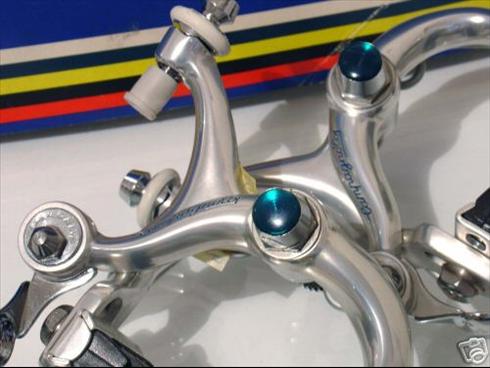
While on the topic of cobalt, I remembered my early fascination for another thing cobalt: the Campagnolo Gruppo Cobalto. If you don't know, Campagnolo SPA is the the name of an Italian high end bicycle component manufacturer. Campagnolo (Campy) parts dominated the high-end bike component markets for years until the Japanese moved in on them, offering more for less. But Campagnolo still led in form plus function.  Here is a photo of the Cobalto brake set I coveted but never owned.

In 1979, I bought a 10 speed bicycle called a Mirella. Here's a link showing what one used to look like.  Mine was gold and not blue. Same chrome lugs. Mafac brakes. I rode that bike 15 miles a day, weather permitting, commuting back and forth to campus. I also rode it around Dane County and around the lakes on weekends.

I crashed the bike once on University Avenue going over some railroad tracks. The front wheel came loose and I planted the fork in the asphalt. I cracked my forearm in the fall but managed to carry the bike back to State St. where I worked before seeking medical attention for myself (the bike was more important to me). The guys at the old Yellow Jersey Coop on State St. were able to straighten the fork for me and a month or so later I was at it again, biking all over Dane County.

Years later I had the original paint stripped and added braze-on fittings for the front derailleur, water bottle cages, and brake line guides across the top tube. I had it painted a bright Italian red. I also upgraded the components with Campy Super Record brakes and a gorgeous Campy Chorus aluminum crank (I still have the original three-pin Campy crank made of chrome-plated steel. I tried to sell it once on eBay but no takers). I also added front and rear Chorus derailliers. And a Cinelli stem. The only thing original (besides the frame) left on it are the high flange Campy hubs and the drop-outs which are part of the frame and thus non-negotiable.

Somebody vandalized my Mirella in Denver. They took the Campy Record quick release skewers, the Super Record brakes, and they were working on taking the seat post. Bastards. I suspected someone in the apartment building because the bike was in a security locked basement at the time.

Here's photo of it now, stowed up in the rafters in the garage. It still works fine:

THIS BIKE IS NOT FOR SALE

Real 10 speeds are so 70's.

The Very First Guinea Pig?

Commenter Ritmo's link to the wiki article about dioxin mentioned guinea pigs, which reminded me of Lavoisier, who may have been the first scientist to test theories using that animal. Lavoisier famously taught that combustion was the combining of oxygen with other elements, overthrowing the older notion of phlogiston which I wrote about here.

According to the OED of etymology, the first recorded use of the term guinea pig in a scientific context dates from the 1920s. However, the following description of the work of Lavoisier and Laplace clearly antedates that usage: link to original

Lavoisier's respiration experiments invalidated the phlogiston theory despite protestations from Priestley and Scheele. Lavoisier collaborated with French mathematician Pierre Simon de Laplace (1749 -1827) on problems in respiration chemistry. Their vital experiments with guinea pigs in 1780 first quantified the oxygen consumed and carbon dioxide produced by metabolism. Over a ten-hour period, they collected approximately 3 g of carbonic acid from an animal breathing oxygen. In a second experiment, they placed a guinea pig into a wire cage, which in turn was placed into a double-walled container. Ice packed into the double walls of the outer container maintained a constant temperature; ice between the cage and the inner wall of the container melted because of the animal's body heat. During 24 hours 13 oz. (370 g) of ice melted. Lavoisier and Laplace concluded that the total heat produced by the animal equaled the amount heat required to melt ice. In their own words:
Respiration is thus a very slow combustion phenomenon, very similar to that of coal; it is conducted inside the lungs, not giving off light, since the fire matter is absorbed by the humidity of the organs of the lungs. Heat developed by this combustion goes into the blood vessels which pass through the lungs and which subsequently flow into the entire animal body. Thus, air that we breathe is used to conserve our bodies in two fashions: it removes from the blood fixed air, which can be very harmful when abundant; and heat which enters our lungs from this phenomenon replaces the heat lost in the atmosphere and from surrounding bodies.
...animal heat conservation is thus largely attributable to heat produced by the combination of humid air inspired by the animals and dry air in the blood vessels.

Lavoisier's ideas were radical for 1780 because they connected heat, work, and energy.